AI-Generated Code Quality Needs Human Acceptance
TL;DR AI-generated code quality checks provide evidence for a decision. A named person must accept a specific delivery against agreed criteria. Review records must expose missing evidence and…


Table of Contents
TL;DR
- AI-generated code quality checks provide evidence for a decision.
- A named person must accept a specific delivery against agreed criteria.
- Review records must expose missing evidence and known exceptions.
- An incorrect acceptance decision needs an explicit correction trail.
For a founder or CTO receiving AI-written work from a contractor, passing tests leaves an important question unanswered: who accepts this delivery, against which requirements, and with what unresolved risks? Acceptance means an accountable person’s recorded decision that a specific version meets agreed conditions. Reviewing AI-generated code supplies evidence for that decision; a green result cannot supply the person’s authority.
Green checks do not identify who accepted the work
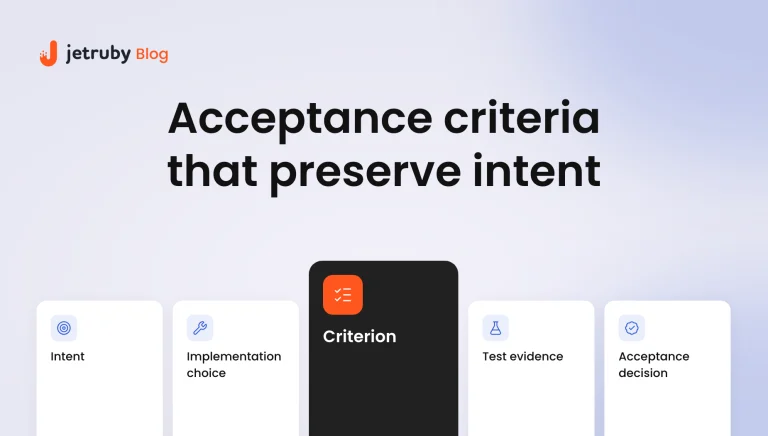
Agree on acceptance criteria before implementation begins. Specify the behavior the business needs, the evidence required to demonstrate it, and the person authorized to decide whether remaining exceptions are acceptable. Otherwise, a contractor can deliver successful checks without establishing whether those checks cover the intended outcome.
Consider a hypothetical refund feature. Tests might confirm that a refund executes correctly while leaving an unresolved question about eligibility. The business owner must settle that rule, and engineering must demonstrate the chosen behavior. Generating more tests against an assumed rule does not resolve the disagreement.
This distinction also separates choosing AI-assisted code review in Rails from deciding whether to accept the resulting work. A review tool can contribute findings. Acceptance still needs an identified decision-maker.

An incorrect acceptance decision can leave a visible record
Our internal marketing strategy history records a premature acceptance and its reversal. For this episode, we show our own record, not a client’s; the work concerned marketing and internal tooling, not a client software delivery.
The following is an anonymized reconstruction of the recorded sequence, not dialogue:

In this process, VERIFY-OK and VERIFY-FAIL describe verification results. PASS records human acceptance. Keeping those meanings separate made it possible to identify the premature decision and preserve its correction.
The evidence supports a narrow claim: an incorrect acceptance became visible and was reversed in this documented instance. The role boundary was procedural. It did not technically prevent an agent from writing an acceptance status.
A detected attribution error changed the procedure
A later internal article trial exposed a related problem: a draft attributed an argument to an expert whose contribution was still missing. A check caught the false attribution before publication. Field findings recorded in September 2026 informed a revision of the article procedure.
The revised procedure specifies five human stops: after evidence gathering, at expert contribution, at engineering review, before final verification, and at acceptance. It also places a preliminary check before expert input and engineering review. That preliminary check produces findings, without authority to issue a final verdict. This is evidence of a correction to the procedure, not proof that the error cannot recur.
Review evidence and business acceptance serve different purposes
Technical review examines implementation quality. Business acceptance determines whether the reviewed delivery satisfies the intended use, including consciously accepted exceptions. These responsibilities need explicit owners even when one person performs more than one function. That division belongs in quality assurance in project management, alongside the evidence required for each decision.
In our process, AI-written code is accepted through two lenses. The technical lens judges code quality against standards our team configures: the review reads the whole diff, the full set of changes, and leaves comments on quality. The business lens takes the work package, a decomposed list of tasks, and checks that the code really implements those tasks. An AI model acts as the judge in this second check. Neither lens replaces the decision itself: ownership of the merge stays with a person.

JetRuby describes a concrete division in the Sortly modernization case: human reviewers checked business logic and architectural consistency, while AI-assisted review examined idiomatic Kotlin, type safety, and potential edge cases. This is separate client experience about review responsibilities; it does not validate the acceptance procedure illustrated by our internal record.
Review effort has its own workload
Historical research helps explain why the distinction matters. METR’s July 2025 preprint studied 16 experienced developers completing 246 tasks in familiar repositories. Developers reported accepting fewer than 44% of AI generations. In a subset of 44 issues with labeled recordings, reviewing and cleaning AI output occupied approximately 9% of working time with AI. Accepting a generation here means retaining model output, not accepting a contractor’s delivery.
Faros’s vendor telemetry report, reflecting analysis as of June 2025 across more than 10,000 developers and 1,255 teams, reported 91% longer pull-request review time and 154% larger average pull requests associated with AI use. These observational comparisons do not establish that AI caused the differences.
In Stack Overflow’s 2025 survey, 66% of respondents to the AI-frustrations question selected “AI solutions that are almost right, but not quite.” This records reported frustration, not a measured defect rate.
These are different populations and measures, not a combined estimate of today’s AI code review bottleneck. METR’s February 2026 update also identified selection and measurement problems in its follow-up experiment, limiting conclusions about current productivity. None of these studies measures the effect of our acceptance proposal.
Ask for an acceptance package before approving delivery
Request a compact acceptance package tied to the actual delivery. The table below is our recommendation drawn from the internal episode; it has not been validated as a universal procedure for client code. If the technical evidence needs another assessment, a free code audit provides a route to request one.
| Request | What the record should establish |
|---|---|
| Acceptance criteria | The intended behavior and conditions agreed before implementation. |
| Delivery version and inputs | The exact revision being assessed and the requirements or specifications it implements. |
| Review evidence | Tests and reviews performed, their results, relevant environment, and what was not checked. |
| Known deviations | Unmet conditions, unresolved findings, and the proposed treatment of each exception. |
| Accepting person | Who has authority to make the decision and which specialist findings support it. |
| Decision and change history | What was accepted or returned, when, why, and which later decision supersedes it. |
Requirements deserve particular attention. Yang and colleagues’ 2026 research manuscript, revised in September, found that ambiguous requirements degraded code-generation performance across the evaluated models and could produce functionally different implementations. Its experiments concern function-level tasks, not complete client deliveries. Our practical inference is to record how disputed requirements were resolved before treating test results as acceptance evidence.
In our process, the requirements a delivery is checked against live in a work package, and the work package is built in steps. A client’s change request (CR) goes first to a business analyst, who turns it into work packages. An architect then adds design and architecture and is the last person to edit the package. Only after that does a developer start, and the developer works only from the agreed work package. A model generates each requirement in the package, and a person checks it. Every one of these stages ends with a human gate: a person reviews what the stage produced.
Return an incomplete package with a specific request
If a report names no delivery version, request the revision it covers. If an exception has no decision, ask the authorized person to resolve it. Missing evidence means the package cannot yet support that part of the decision; it does not automatically prove the code is defective.

To keep review manageable, ask the contractor to connect each material finding to the relevant criterion and identify the decisions still needed. That is a proposed working practice, not a measured promise of shorter queues.
Preserve a mistaken decision when correcting it
When acceptance proves premature, record that the earlier decision has been withdrawn, explain why, and identify the replacement version or review required. Preserve the earlier entry so another reviewer can reconstruct what changed. Fresh evidence should support any renewed acceptance.
Withdrawing a decision does not itself roll back deployed software. Operational remediation needs its own engineering assessment.
The example demonstrates reversibility, not automatic enforcement
Limitation: our internal record demonstrates one visible correction in marketing and tooling work. It establishes neither a failure rate nor improved client delivery performance. It also does not establish that an unauthorized acceptance entry is technically impossible.
Applying this proposal to software requires engineering judgment about the product, the consequences of failure, and the evidence appropriate to each change. A complete-looking package can still contain weak tests or mistaken assumptions. The accepting person needs enough understanding, supported by qualified reviewers, to challenge its contents.
Summary
AI-generated code quality becomes useful decision evidence when it is tied to agreed requirements and an identifiable delivery. Human acceptance adds the accountable decision: what is accepted, which exceptions remain, and why. Ask your contractor for that record, return gaps with specific requests, and preserve corrections when decisions change.
If you need another assessment of the code before deciding, Request a free code audit.