Definition of Ready: Checklist, Examples, and AI Coding
TL;DR A Definition of Ready establishes whether a task is sufficiently understood to begin. A useful checklist connects the user, scope, expected behavior, dependencies, open questions, and decision…


Table of Contents
TL;DR
- A Definition of Ready establishes whether a task is sufficiently understood to begin.
- A useful checklist connects the user, scope, expected behavior, dependencies, open questions, and decision owner.
- Definition of Ready concerns starting work; Definition of Done concerns the completed result.
- Before an AI agent executes a task, consequential assumptions need an explicit decision or an agreed route for clarification.
A Definition of Ready helps a team decide whether work can start. This guide explains its components, applies a practical checklist, distinguishes readiness from completion, and then examines what people should settle before an AI agent writes code. For founders and CTOs, that connects directly to product discovery and scoping: a written request can still contain an unresolved product decision.
Contents
What is a Definition of Ready?
A Definition of Ready, or DoR, is an agreed set of conditions used to assess whether a work item is clear and feasible enough to begin. It makes readiness discussable before implementation. Atlassian’s explanation connects it to understanding users, goals, scope, technical needs, and completion criteria. [Accessed September 25, 2026 | primary practitioner guidance]
For a founder, the useful question is whether the team can explain the intended outcome without privately choosing between conflicting interpretations. The amount of documentation alone cannot answer that question.

What should a Definition of Ready include?
A useful Definition of Ready identifies the decisions and evidence needed for the next action. The following editorial checklist is a starting point for discussion, not an established JetRuby standard or a universal requirement for every team.
A practical readiness checklist
- Purpose and user: State who needs the change and what they should be able to accomplish. “Help account administrators export filtered records” is more actionable than “improve reporting.”
- Boundaries: Identify what the task includes and excludes. Distinguish a manual export from scheduled delivery or a new reporting dashboard.
- Observable result: Describe behavior someone can check. Specify which records appear in the output and what happens when no records match.
- Constraints and dependencies: Identify required data, access, interfaces, and agreed technical limits. Record whether each dependency is available for the proposed work.
- Open questions: List unresolved choices and the next action for each. Distinguish a question to investigate from a behavior the implementation must already settle.
- Decision owner: Identify the person who can resolve conflicting interpretations and record the choice where the team can find it.
Broader business requirements analysis supplies context for these decisions. The readiness check brings that context down to a particular task.
Our own process answers the question of when work may start with one condition. A client’s change request (CR) goes first to a business analyst, who turns it into work packages. An architect then adds design and architecture to the work package and is the last person to edit it. A developer starts only after that and works only from the agreed work package. A model generates each requirement in a work package, and a person checks it. Every stage ends with a human gate, where a person reviews the output. What blocks implementation is the absence of an agreed work package.

What does a Definition of Ready look like in practice?
A readiness check turns an unresolved choice into an agreed next step. Consider an illustrative task: “Let administrators export customer records.” This is a teaching example, not a JetRuby client case.
The user and purpose are recognizable, but the output remains ambiguous. Does the export contain all records or only those matching the current filters? A developer could implement either interpretation without resolving the underlying disagreement.
From an open question to an agreed next step
In this illustration, the decision owner selects the filtered view. The task now states that the export contains the matching records and agreed columns; an empty result produces a file containing only column headings. Scheduled exports are excluded. The team checks access to the relevant data before implementation.

If access remains uncertain, a separate investigation can establish feasibility and return evidence for a decision. That narrower assignment has its own expected result; it does not silently authorize the feature build.
A separate, documented discovery example comes from JetRuby. Its portfolio, checked live on September 25, 2026, describes a month of inception and a Functional Requirements Document (FRD), which records required behavior, before development in a luxury-watch community platform discovery example.
This is an example of JetRuby’s discovery work, not evidence that the agent workflow described here was used on that project. It establishes neither a universal discovery duration nor a measured benefit from this checklist.
How is Definition of Ready different from Definition of Done?
Definition of Ready assesses preparation to start; Definition of Done assesses whether completed work meets the agreed completion conditions. The distinction follows Atlassian’s explanation cited above.
| Check | Definition of Ready | Definition of Done |
|---|---|---|
| Timing | Before implementation | When evaluating completed work |
| Subject | Understanding and feasibility | The resulting work and its quality |
| Question | Can this task begin? | Does this result meet completion conditions? |
| Evidence | Agreed scope, resolved choices, available dependencies | Demonstrated behavior and required checks |
Where acceptance criteria fit
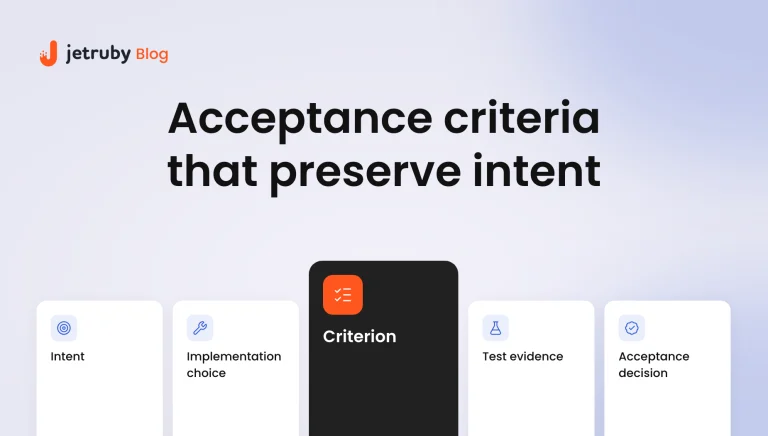
Acceptance criteria describe expected behavior for a particular task. In the export illustration, they specify which records the file contains. Agreeing on that behavior supports readiness; testing the implementation supplies evidence afterward. The written criterion does not demonstrate that the feature works.
The same distinction applies to accepting AI-generated work: preparation and evaluation remain separate responsibilities.
What changes when an AI agent writes the code?
When an AI agent writes code, the readiness discussion should explicitly identify assumptions that would change the intended behavior. An agent may produce a plausible implementation without establishing which interpretation the person requesting it intended.
What ambiguity studies show—and what they do not
Yang and colleagues studied 1,304 function-level tasks derived from HumanEval+ and BigCodeBench, with four ambiguity types. Their September 16, 2026 arXiv revision reports an average decline of 7.22 percentage points in pass@1, the estimated probability that a single generated solution passes the task’s tests. Clarity Is Not Assumed, v2.
The ClarifyCodeBench preprint, revised August 31, 2026, evaluates six models and reports that stronger code generation does not necessarily mean better clarification. Clarification performance also deteriorates as ambiguities accumulate.
These studies concern the tested models and benchmark conditions. They do not measure project delivery speed, cost, or this checklist’s effectiveness. Our practical inference is to make unresolved decisions explicit before execution; neither study establishes that humans universally outperform agents.
The decisions a person must settle before execution
JetRuby’s internal marketing and tooling record provides a concrete process example: we show our own record, not a client’s. The recorded workflow requires a human stop after evidence gathering, before drafting, and discussion of alternatives before planning. Consequential choices are resolved individually rather than buried inside a completed plan.

Agents run the assigned work within that process; the human decision establishes which direction it should take. For the illustrative export task, the corresponding decision is which records users should receive. The agent can help expose alternatives, but a plausible implementation is not evidence that the product choice was agreed.
Limitation: This record documents internal practice. It does not establish that the workflow was used to deliver client software or that it improves delivery metrics.
Who checks readiness, and when should work wait?
Readiness needs shared understanding between the people requesting, implementing, and evaluating the work, with a clear owner for unresolved decisions. Those responsibilities need not correspond to identical job titles in every organization.
In the export illustration, uncertainty about the intended records prevents a settled implementation target. Uncertainty about data access can instead define an investigation. Readiness therefore depends on the action being authorized: investigating feasibility and delivering a feature require different evidence.
Our stopping rule starts with a simple test: is there a formal request? If there is none, it is not a change request (CR). Ideas are ideas, and we take only CRs into work. To turn an idea into a CR, we run product sessions and ask about the pain: what do you want to solve? An analyst helps pull out the real need and distill it, the requirements are agreed with the client, and only then does work begin.
A readiness check is not an automatic enforcement mechanism
The internal tooling can indicate that discussion was skipped. That indicator makes a missing step visible; it does not technically prevent continuation. The stopping requirement comes from workflow instructions, and its observance still requires people to act on it.
A checked box cannot substitute for the discussion that resolves a choice. The record should preserve the decision, its owner, and what work it authorizes.
Summary
A Definition of Ready connects a task to sufficient understanding for its next step. Establish the user, boundaries, observable result, dependencies, open questions, and decision owner. Keep readiness separate from evidence that completed work meets expectations. Before agent execution, make consequential choices explicit and identify where clarification must return to a person.
If those choices are still scattered across conversations, JetRuby can help structure the discovery discussion.