AI-Enhanced Level 4 Support Automation: How a 2–3 Week R&D Solves a Universal Enterprise Problem
Discover how JetRuby built an AI-enhanced Level 4 support automation system in 2–3 weeks to cut misconfiguration tickets by up to 50% for enterprises.
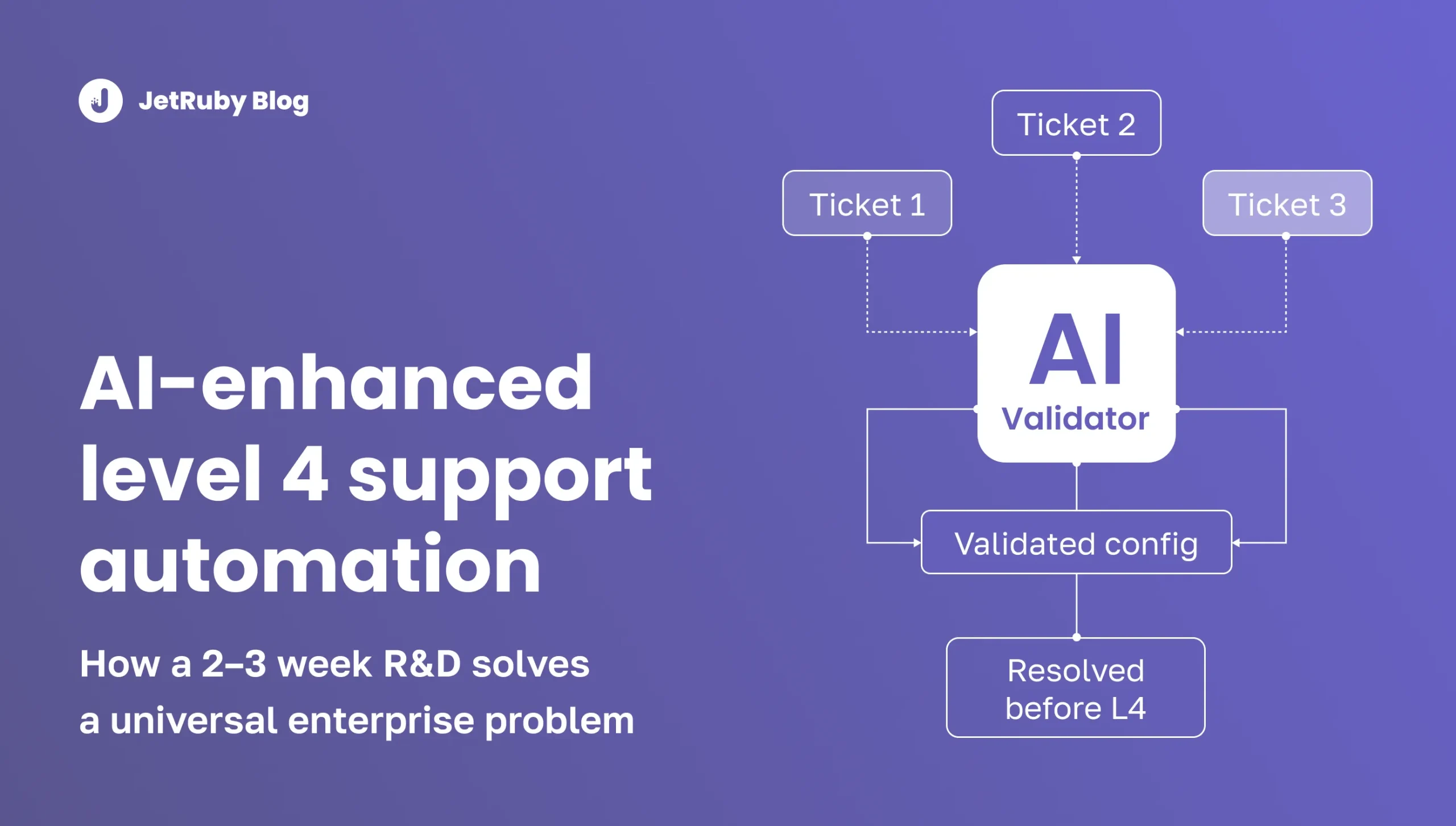

Table of Contents
In large enterprise environments, where dozens of engineering teams and hundreds of people work on the same platform, configuration accuracy becomes a constant challenge. Fragmented application ecosystems, long implementation cycles, and frequent product updates mean that even small misconfigurations quickly turn into costly support tickets.
Surprisingly, most of these issues are not real software defects.
They are preventable mistakes — someone misread documentation, missed a dependency, or entered 100 instead of 10.
At JetRuby, we set out to address this problem by building an AI-enhanced Level 4 Support Automation system as part of a fast 2–3 week R&D initiative. Even though the client ultimately addressed the issue internally, the system we built targets a fundamental pain point shared by nearly all enterprise vendors that ship configurable developer tools.
This is the story of how JetRuby built it — and why it matters.
The Problem: 50–70% of L4 Support Tickets Are Only Misconfigurations
For companies that build developer tools, SDKs, libraries, or integration platforms, the typical escalation flow looks like this:
- A customer or integrator configures the platform based on documentation
- Something doesn’t work
- A support ticket is opened
- The ticket moves from L1 → L2 → L3 → and finally L4
- Once it reaches engineering, the “critical issue” turns out to be an incorrect configuration
Across the industry, 50–70% of Level 4 tickets fall into this category.
This creates a dual-layer problem.
For the vendor (tool producer)
Highly skilled engineering teams spend significant time on:
- Analyzing misconfigurations
- Identifying deviations from documentation
- Explaining basic configuration rules
This slows product development, drains R&D resources, and reduces the team’s ability to focus on innovation.
For the companies integrating these tools (the key pain point)
Even minor misconfigurations can:
- Break business-critical processes
- Cause major downtime
- Interrupt business continuity
- Trigger costly escalations
- Lead to financial and reputational damage
During incidents, teams often change settings “on the fly” without documentation, which prolongs recovery and destabilizes environments even further.
This is where automated validation delivers the highest value.
The Idea: A Self-Service Config Validator with Built-In AI
At JetRuby, we identified that most L4 tickets were caused by configuration errors. The core idea was simple: give administrators a way to validate configurations before they ever reach engineering.
We designed a lightweight online validation service where users upload configuration files (YAML or JSON), and the system automatically checks them against a structured rule set.
This eliminates:
- Manual documentation searches
- Waiting for Level 4 engineers
- Engineering team interruptions
A Domain-Specific Language for Rules (DSL)
To make the system adaptable across industries, JetRuby built a custom Domain-Specific Language (DSL) for defining configuration rules.
The DSL allows enterprises to define:
- Acceptable value ranges
- Conditional dependencies
- Required versions
- Feature enable/disable logic
- Semantic and consistency constraints
Instead of hardcoding validation logic, the DSL provides structure, flexibility, and maintainability.
AI-Enhanced Validation (Context + Rules)
On top of strict rule validation, JetRuby added an AI layer.
The AI receives:
- The uploaded configuration
- The rule set
- Relevant documentation snippets
Using this context, the AI generates human-readable explanations when a configuration is invalid.
Rather than complex formulas or cryptic errors, users receive clear guidance on what is wrong and how to fix it.
The Impact: Cut Level 4 Support Effort by 50%
By shifting validation into an automated, self-service system, enterprises can:
✓ Reduce Level 4 developer involvement by up to 50%
✓ Accelerate validation for implementation teams
✓ Reduce miscommunication and documentation errors
✓ Free R&D to focus on real product innovation
✓ Improve first-time-right configuration and customer experience
Instead of debugging YAML files, engineering teams can focus on building new product capabilities.
Technology Stack
We built the system with modern, enterprise-friendly technologies:
- Backend: Java
- Frontend: React
- Rules Engine: Custom DSL built internally
- AI Layer: Prompt-based contextual validator
This makes the tool easy to integrate into existing enterprise ecosystems.
Current Limitations (and opportunities)
At the moment, the system supports:
- YAML
- JSON
If a company uses a proprietary format, the validator can be extended.
Need support for your custom config format? Contact us — we can add it.
Why This Matters for Every Developer-Tool Vendor
Whether a company builds SDKs, integration frameworks, developer platforms, or configurable modules, the underlying issue is the same:
Complex configuration landscapes lead to widespread, invisible, and preventable misconfigurations — responsible for 50–70% of L4 tickets and a significant share of downtime incidents.
JetRuby’s R&D demonstrated that:
- A simple 2–3 week AI-driven prototype can eliminate up to half of these issues across any platform.
A focused 2–3 week AI-driven prototype can eliminate up to half of these issues across many platforms.
We are now packaging this system as part of JetRuby’s internal R&D portfolio and enterprise solution toolkit.
The Threefold Misconfiguration Problem in Large Global SaaS Deployments – aka “Configuration drift”
1. Initial Setup Is Impossible to Monitor at Scale
In large worldwide SaaS deployments, each customer site or regional office configures the application differently.
- There may be hundreds or thousands of settings, each with dependencies and recommended defaults.
- Local admins often don’t read or follow the manual, or interpret it inconsistently.
- There is no unified visibility into how each environment is configured.
- Vendors cannot easily confirm: “Is this instance set up correctly?”
Result: An enormous configuration surface area with no central oversight.
2. Because You Can’t Monitor Setup, You Can’t Audit or Default Correctly
Without a way to validate configuration correctness or drift, several downstream issues follow:
- There is no automated cross-reference against recommended values.
- There is no “reset to manufacturer defaults” or sanity-check mechanism.
- Misconfigurations accumulate silently.
This drives 50%–60% of all L4 support tickets in major SaaS ecosystems, tickets that are completely preventable with modern tooling.
Result: Support teams spend time solving problems that should never have happened.
3. Misconfigurations Become Extremely Costly During Outages
When something breaks, business continuity issues, module failures, downtime, teams on the ground scramble:
- They make rapid, undocumented, untraceable changes across dozens of settings.
- At the moment, these changes feel necessary but they destabilize the system further.
- Once the configuration baseline is lost, recovery becomes manual and slow, often requiring a line-by-line recheck of settings.
These misfires account for up to 50% of preventable downtime costs every month in large SaaS deployments.
Result: Outages last longer, costs spike, and the configuration state becomes even harder to trust.
The Core Insight
Misconfigurations are:
- Widespread (happening across global deployments)
- Invisible (no monitoring, no auditing, no baselines)
- Preventable (with the right automated configuration intelligence)
And the moment things go wrong, misconfigurations multiply and cascade, making recovery exponentially harder.
Want to See the Tool Live?
The system is fully functional and ready for demo.
If your enterprise struggles with repetitive configuration issues or heavy Level 4 support load, JetRuby would be happy to walk you through the solution and discuss adaptation for your platform.
→ Contact us to schedule a demo or discuss adaptation for your platform.


