JetRuby Flow: A Transparent and Predictable Alternative to Fixed Price and Time & Material
JetRuby Flow is a transparent delivery framework that offers a predictable alternative to Fixed Price and Time & Material for modern product teams.
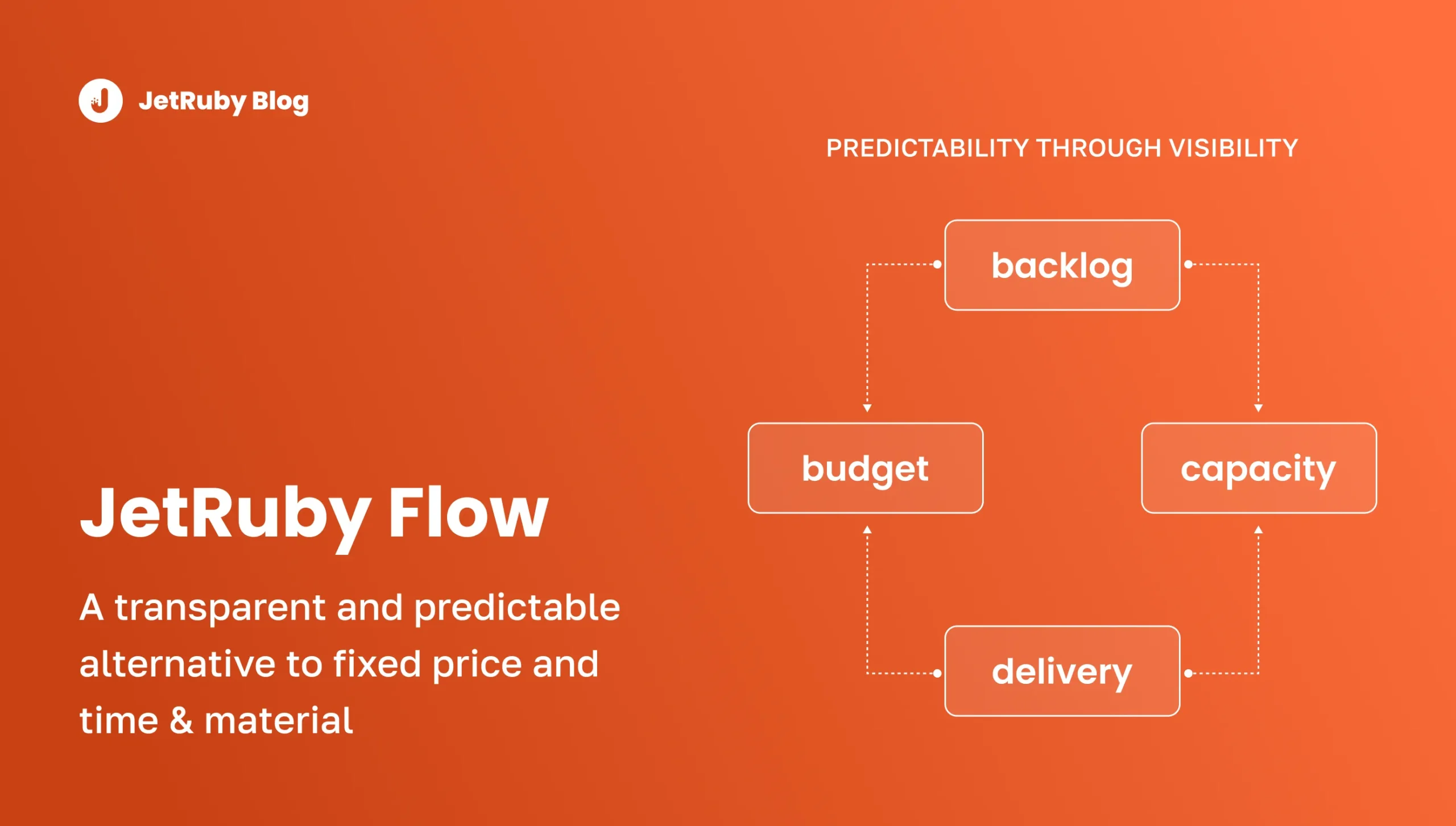

Table of Contents
Why software delivery models keep failing founders
If you have worked with external development teams before, you likely have a scar or two.
The symptoms are painfully familiar:
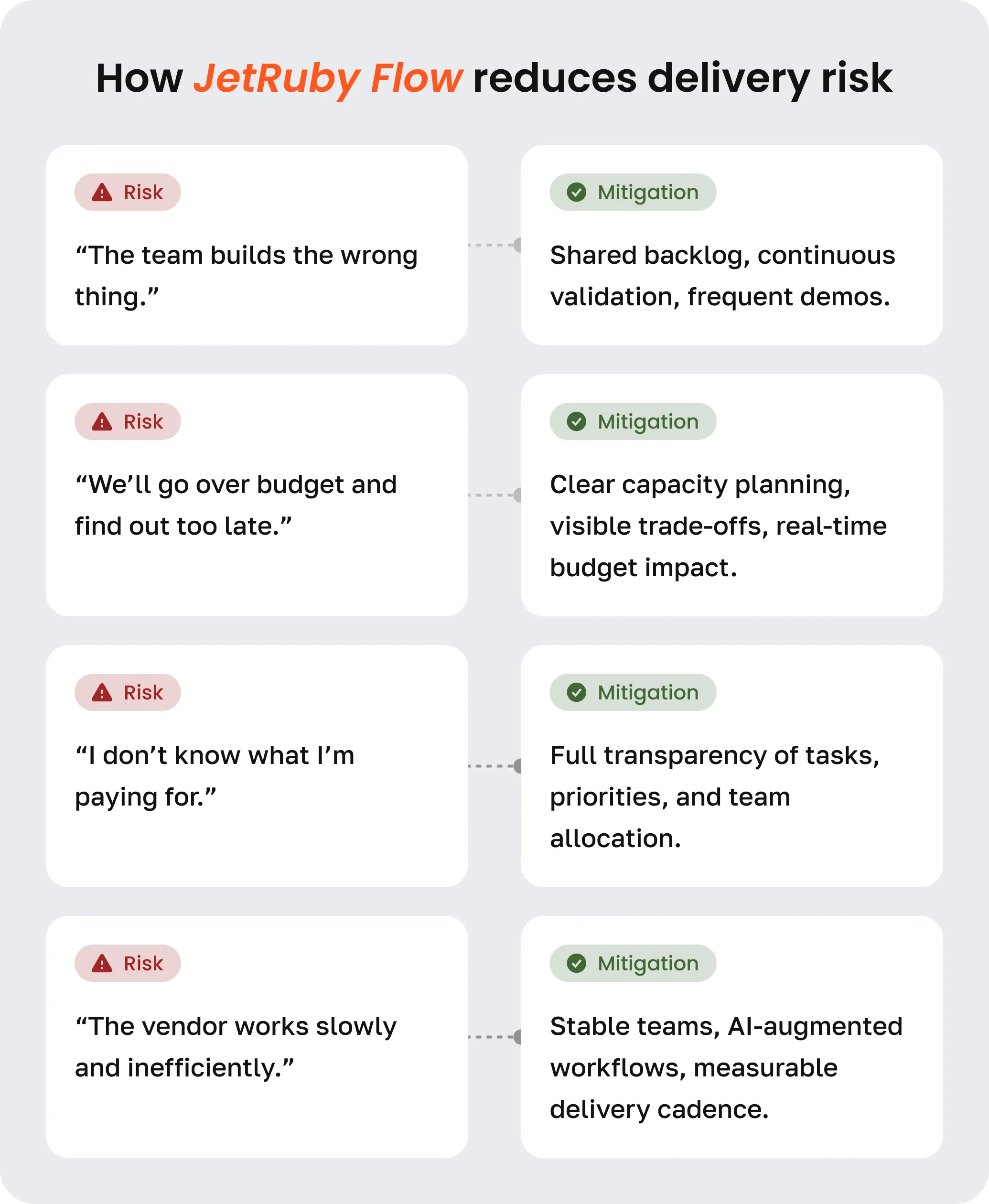
- “They built something, but not what I actually meant.”
- “The budget quietly doubled, and we only realized it when it was too late.”
- “I’m paying every month, but I don’t really understand what the team is doing.”
- “I was forced to choose between Fixed Price or some vague Time & Material setup.”
These failures are rarely caused by bad intentions or weak engineering skills. They are almost always a result of broken delivery models that turn product development into a black box.
JetRuby Flow was created to address these systemic problems. It is a delivery framework designed to make software development transparent, predictable, and collaborative while preserving flexibility.
The real problem with Fixed Price
Fixed Price feels safe on paper. Scope, budget, and deadlines look clear and reassuring. In reality, Fixed Price creates three structural issues.
- You overpay for risk upfront
To protect themselves, vendors add a 30–50% risk premium. You pay for uncertainty before it even materializes. - Change becomes the enemy
As soon as the contract is signed, learning becomes expensive. Every new insight becomes a change request, a negotiation, or a conflict. - Incentives are misaligned
The vendor is motivated to deliver exactly what is written — not what yields the best business outcome.
For early-stage startups and evolving products, Fixed Price is less about predictability and more about false certainty.
Why classic Time & Material doesn’t solve it either
Time & Material (T&M) removes rigid scope, but introduces a different kind of anxiety.
- You pay for hours, not outcomes
- Progress is hard to evaluate
- Budget risks are pushed entirely onto you
Without a strong process, T&M often turns into a monthly invoice with little clarity on:
- What was actually achieved
- Why did certain tasks take so long
- How today’s work impacts tomorrow’s budget
The result is another black box — just a more flexible one.
JetRuby Flow: delivery without the black box
JetRuby Flow is built on a simple idea:
You should always understand what the team is doing, why they are doing it, and how it affects your budget and timeline.
Instead of fixing scope or selling raw hours, JetRuby Flow focuses on flow predictability.
It answers three questions continuously:
- What are we building next — and why?
- How much team capacity does it require?
- How does this translate into cost and delivery timelines?
Core principles of JetRuby Flow
1. A shared backlog instead of a hidden scope
There is no “vendor backlog” and “client backlog”. There is one shared backlog, visible to everyone.
Together with the client, we:
- Define problems, not just tasks
- Break work down to delivery-ready items
- Continuously reprioritize based on business value
This eliminates the classic “That’s not what we meant” problem. Misunderstandings surface early — when they are still cheap to fix.
2. Fixed team, fixed rhythm — flexible scope
JetRuby Flow keeps the team structure stable by maintaining fixed roles and team composition, a predictable sprint cadence, and a consistent delivery velocity.
What stays flexible is scope, not people.
This creates clear trade-offs:
- Add more features → extend timeline
- Speed up delivery → reduce scope
- Keep budget stable → adjust priorities
No hidden compromises, no surprise invoices.
3. Transparent link between tasks, capacity, and budget
Every backlog item is estimated by delivery complexity, not abstract story points.
Clients can always see:
- What the team is working on now
- What is planned next
- How much capacity is available
- How current priorities impact cost
Budget becomes a management tool, not an after-the-fact report.
4. Honest pricing without risk padding
Unlike Fixed Price models, JetRuby Flow removes artificial risk margins from pricing.
Clients pay for the actual team and the real complexity of the work being delivered, rather than for hypothetical uncertainties priced in upfront.
Delivery risk is managed through transparency, shared planning, and ongoing collaboration, not through hidden markups embedded in the contract.
Built for modern teams: AI as a delivery accelerator
JetRuby Flow is designed for teams that expect modern engineering practices by default, not as an afterthought. AI is not treated as a separate toolset or a marketing layer added on top of delivery — it is embedded directly into the day-to-day workflow.
AI supports backlog refinement and task decomposition, assists with code generation and reviews, accelerates test creation and regression coverage, and improves documentation and knowledge sharing across the team. As a result, teams move faster without sacrificing quality, reduce routine engineering overhead, and concentrate human effort where it matters most: product thinking, architecture, and critical technical decisions.
For clients, this translates into shorter feedback loops and better cost efficiency.
How JetRuby Flow reduces delivery risk
Who JetRuby Flow is for
JetRuby Flow works best for:
- Founders and CEOs building evolving products
- CPOs and tech leaders scaling existing platforms
- Teams that value predictability without rigidity
- Companies are tired of vendor-driven black boxes
It is especially effective when:
- Requirements are expected to change
- Speed to market matters
- Budget control is critical
Who it is not for
JetRuby Flow may not be the best fit if:
- You have a fully frozen scope and zero tolerance for change
- You prefer minimal involvement in product decisions
Transparency requires participation.
From contracts to collaboration
JetRuby Flow focuses on making delivery explicit and understandable.
When all participants work from the same backlog, align on the same priorities, and operate within clearly visible constraints, software development moves out of the realm of assumptions and guesswork. It becomes a managed, inspectable system with clear signals and feedback loops.
For experienced founders and product leaders, this clarity is critical. It replaces blind optimism with situational awareness — the ability to know where a project truly stands at any moment, and to make informed decisions before risks turn into failures.
Final thought
For years, the software industry has framed delivery as a false dichotomy: either you lock everything upfront and pay for an illusion of certainty, or you accept total flexibility at the cost of predictability and control.
In practice, neither extreme works for modern product development.
JetRuby Flow is built on a different assumption: predictability does not come from frozen scope or blind trust — it comes from visibility, shared decision-making, and disciplined execution. When backlog, priorities, capacity, and budget are continuously connected, delivery stops being a leap of faith and becomes a system you can reason about.
Product development is inherently uncertain. JetRuby Flow makes that uncertainty explicit, manageable, and economically honest.
Not a black box. Not a contractual gamble.
A delivery flow you can inspect, influence, and confidently manage.


