Key Tech Trends for 2026 You Should Watch Now
Discover the key tech trends shaping 2026, from AI co-workers and synthetic data to edge computing, low-code development, and multi-cloud intelligence. Stay ahead with JetRuby insights.
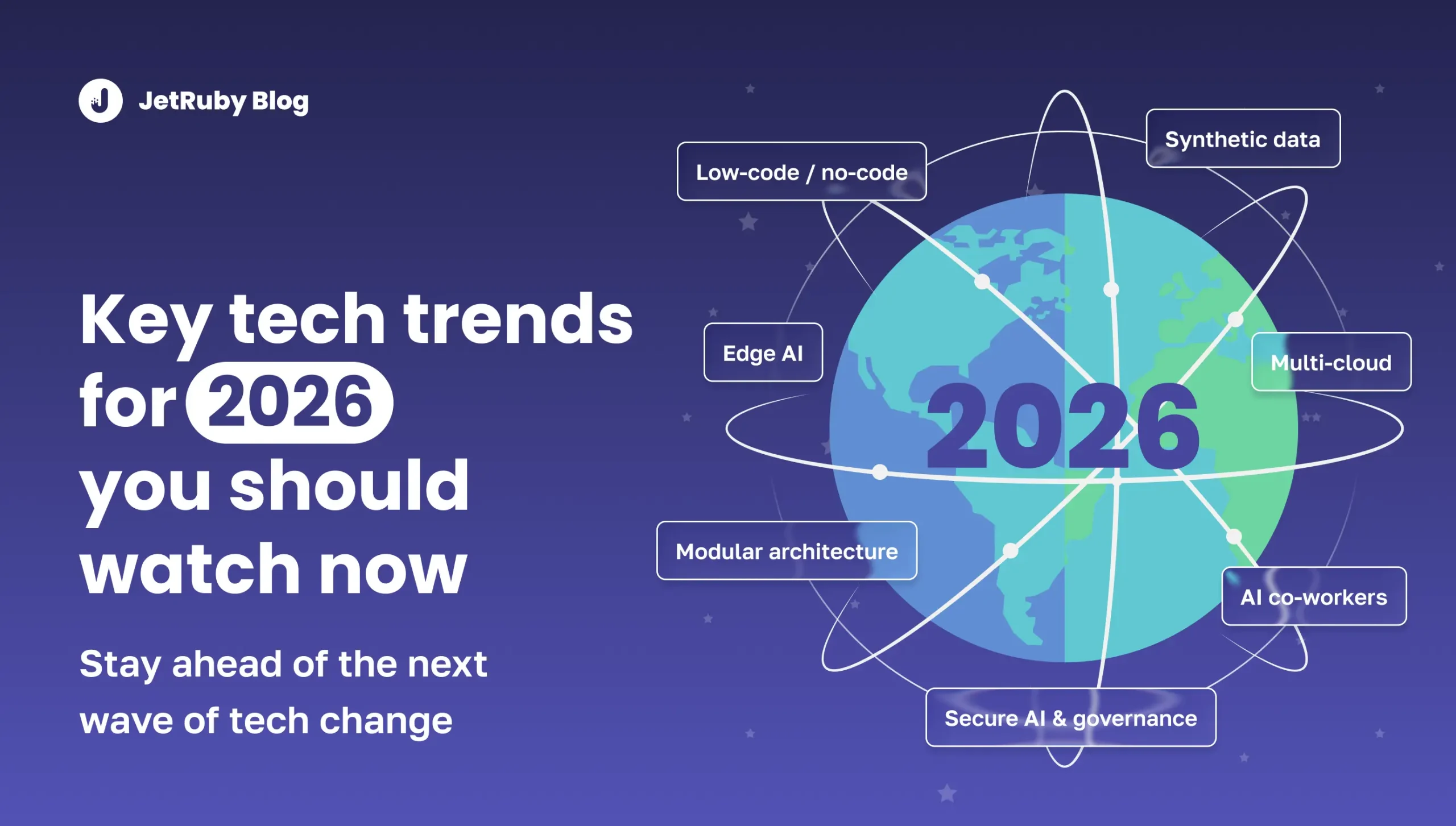

Table of Contents
The pace of technological evolution continues to accelerate, and 2026 is shaping up to be one of the most transformative years in recent tech history. Companies that start paying attention now will be better positioned to innovate, scale, and stay competitive. Based on what is already emerging across AI, digital product strategy, and enterprise infrastructure, here are the most important tech trends you should start watching and preparing for.
1. AI Evolves From Copilot to Co-Worker
The last few years introduced the world to AI copilots that assist with writing, coding, analysis, and communication. In 2026, AI is transitioning from a supportive tool to a full-fledged operational partner. Autonomous agents will be capable of handling entire workflows, coordinating multi-step tasks, and making context-aware decisions without human hand-holding.
Teams will increasingly rely on AI for:
- Managing operational workflows end-to-end
- Coordinating communication between tools, services, and datasets
- Monitoring, validating, and optimizing business processes
Organizations that adopt these systems early will achieve dramatic performance gains while freeing human teams to focus on strategy and creativity.
2. Synthetic Data Becomes a Strategic Engine for Innovation
As global privacy regulations tighten and access to real user data becomes more restricted, synthetic data is emerging as a powerful alternative. In 2026, it will play a central role in model training, product testing, personalization, and privacy-compliant analytics.
High-fidelity synthetic datasets allow companies to experiment without risking exposure of sensitive information. They reduce the cost and complexity of data collection, accelerate QA cycles, and enable hyper-personalized customer experiences without relying on real individuals’ profiles. What was once a niche research tool is becoming a mainstream driver of product development and innovation that is compliant with regulations.
3. Secure AI and Governance Frameworks Move to the Forefront
As AI systems become increasingly autonomous and deeply integrated into operations, the need for robust governance grows. In 2026, companies will treat AI safety and compliance with the same seriousness as cybersecurity.
Modern AI governance will rely on:
- Continuous model monitoring and bias detection
- Clear data lineage for auditing and transparency
- Integrated policy engines that enforce regulatory requirements
Organizations that implement strong governance frameworks will gain trust and avoid costly operational risks as global regulations continue to evolve.
4. Ultra-Modular Product Architectures Replace Legacy Complexity
The debate between monoliths and microservices is giving way to a more fluid and practical approach: modular, composable architecture. This shift allows companies to scale features selectively, experiment more easily, and integrate external services with minimal friction.
In 2026, modular systems will become the default for companies seeking agility and resilience. Products will function as ecosystems of components that can be deployed, updated, and replaced independently, transforming digital products into flexible, rapidly evolving platforms.
5. Edge AI Adoption Surges Across Sectors
Improvements in hardware efficiency and model optimization are pushing AI intelligence closer to where data is generated. Instead of sending everything to the cloud, 2026 is expected to see a significant rise in edge-based AI, enabling real-time processing for industries such as manufacturing, automotive, retail, and consumer electronics.
From anomaly detection on factory floors to smart AR devices that interpret surroundings on-device, edge AI reduces latency, strengthens privacy, and increases reliability. Companies building data-heavy applications must begin preparing now for hybrid cloud–edge architectures that will dominate the next generation of intelligent systems.
6. Human–Tech Interfaces Enter a New Era
User interactions are becoming more natural, contextual, and immersive. In 2026, interfaces will rely significantly less on traditional screens and more on voice, gesture, ambient cues, and predictive automation.
“Nearly 80% of consumers rely on zero-click search results for at least 40% of their queries.”
AI-enabled voice agents will be embedded across devices, and sensors will interpret physical gestures. Systems will anticipate user intent before an explicit command is given. This evolution requires rethinking UX design principles: products must communicate clearly, adapt intelligently, and blend seamlessly into daily routines rather than demanding constant attention.
7. Low-Code/No-Code Unlocks AI-Native Product Development
Low-code tools have matured rapidly, and in 2026, they will empower non-technical teams to build sophisticated AI-driven applications. What once required full engineering teams can now be orchestrated through visual workflows enhanced by AI agents that generate logic, integrations, and even user interfaces on demand.
This democratization allows:
- Rapid prototyping and iteration without heavy engineering involvement
- Faster deployment of internal automation solutions
- Reduced development bottlenecks for product teams
Companies that embrace low-code early will deliver value faster and remain more adaptable in a competitive landscape.
8. Multi-Cloud Intelligence Becomes the Enterprise Standard
Vendor lock-in is losing its appeal as businesses shift toward intelligent, flexible multi-cloud ecosystems. In 2026, AI-based cloud brokers will dynamically route workloads to the most efficient provider, optimize cost per computation, and ensure robust failover without manual intervention.
Data fabrics will unify analytics across environments, providing enterprises with a single, coherent layer of governance while maintaining the flexibility to deploy services where they make the most sense. This approach maximizes resilience and agility, both essential in an era of AI-accelerated change.
Final Thoughts: 2026 Rewards Those Who Prepare Today
The technological world in 2026 will be defined by companies that embrace autonomy, modularity, and intelligence at every level of their operations. Investing now in AI agents, synthetic data, governance frameworks, modular architecture, and next-generation interfaces will enable organizations to innovate more quickly and adapt more effectively.
The future is arriving quickly, and those who move early will lead it.


