Business Requirements Analysis: Business, Technical, and Reporting Needs
Learn how to analyze business requirements in eight steps, prioritize needs, validate outcomes, and turn findings into clear, traceable product requirements.


Table of Contents
A business idea can sound straightforward until different people start describing what they expect from it.
A business owner may want to increase customer retention. A sales manager may ask for a faster way to manage leads. A product manager may suggest a new dashboard, while an engineer may immediately start thinking about APIs, integrations, and database changes.
None of these perspectives is necessarily wrong. The problem is that they describe different levels of the same initiative.
This is where business requirements analysis becomes important. It helps a team move from a business problem and a desired outcome to requirements that can be understood, prioritized, validated, and eventually connected to a product or process change.
Good analysis is therefore not just about collecting requirements. It helps answer a broader set of questions: What problem are we solving? Who is affected? What outcome are we trying to achieve? What constraints do we need to consider? Which requirements matter most? And how will we know that the final solution addresses the original business need?
This article walks through the business requirements analysis process in eight steps, explains practical business requirements analysis techniques, and uses an illustrative example to show how a business need can become a clear and testable requirement.

What Is Business Requirements Analysis?
Business requirements analysis is the process of examining a business need, understanding the people and processes affected by it, and translating that understanding into requirements that can guide further product or business decisions.
One of the most important parts of this process is keeping different types of requirements separate.
A business need explains why a change is needed. A business requirement describes the outcome the business expects to achieve. Stakeholder requirements describe what particular stakeholders need in order to perform their roles or address their concerns. Functional and technical requirements move closer to the solution and describe what the solution needs to do and what constraints it must satisfy.
IIBA distinguishes between business requirements, stakeholder requirements, and solution requirements, with functional and non-functional requirements belonging to the solution level, as described in its Business Analysis Standard. This distinction helps prevent a common problem: treating a proposed feature or implementation detail as if it were the original business requirement.
For example, consider an appointment-booking product:
| Level | Example |
| Business need | Customers abandon the appointment process because booking takes too long. |
| Business requirement | Reduce the average time required to complete an appointment booking. |
| Stakeholder requirement | Clinic staff need visibility into available and reserved appointment slots. |
| Functional requirement | The system must display available appointment slots and allow customers to select one. |
| Technical requirement | Appointment availability must be synchronized with the clinic's scheduling system. |
The difference is subtle but important. “Build a mobile booking screen” is already a solution idea. “Reduce the time required to book an appointment” describes the business outcome that the solution is expected to support.
The analysis should preserve that connection throughout the project.
What Is the Result of Business Requirements Analysis?
There is no single document that every project needs.
Depending on the context, the output may be a business requirements document (BRD), a product backlog, a set of process models, a requirements repository, user stories, acceptance criteria, or a combination of these artifacts. A BRD is one possible way to organize project objectives, scope, stakeholders, requirements, constraints, and success criteria, but it is not the only format available.
What matters is whether the resulting information is usable.
At the end of the analysis, the team should have a shared understanding of the business problem, the desired outcome, the relevant stakeholders, the scope and constraints, the requirements and their priorities, and the criteria that will be used to evaluate them.
That shared understanding provides the foundation for the next stages of product discovery and delivery.
Before You Start: Goal, Scope, and Stakeholders
The quality of requirements depends heavily on the quality of the context around them. Before asking stakeholders what they want the product to do, it helps to establish why the initiative exists and who is involved in the decision.
Step 1: Define the Business Goal
Start with the problem or opportunity rather than with a list of features.
Ask what the organization is trying to change and what measurable outcome would indicate progress. If there is already a relevant business metric, identify it and, ideally, the person responsible for it. For a broader set of questions to clarify before development, see our guide to questions to ask before starting a digital project.
For example:
Goal: Reduce the average time customers need to complete an online appointment booking from eight minutes to less than three minutes.
This does not tell the team what to build. That is precisely why it is useful at this stage.
Once the goal is explicit, proposed requirements can be assessed against it. A dashboard, a mobile app, an integration, or an automated notification may all sound useful, but their relevance depends on whether they contribute to the outcome being pursued.
It is also worth recording assumptions at this point. If the team assumes that booking time is the main reason customers abandon the process, that assumption may need to be tested rather than silently treated as fact.
Step 2: Map the Stakeholders
The person who requested a project is rarely the only person whose requirements matter.
A stakeholder map helps identify decision-makers, people affected by the change, subject-matter experts, end users, technical teams, and people responsible for constraints such as compliance or operations.
| Stakeholder | Interest | Influence | What to understand |
| Product owner | High | High | Business outcome and scope |
| Operations manager | High | High | Current workflow and operational constraints |
| Customer support | High | Medium | Frequent customer problems |
| End users | High | Medium | Actual behavior and expectations |
| Engineering team | Medium | High | Existing system constraints and dependencies |
| Compliance/legal | Medium | High | Applicable rules and restrictions |
This map is particularly useful when stakeholders have different expectations.
Suppose an operations manager wants the system to expose only appointment slots that have been explicitly approved, while a marketing manager wants customers to request alternative times when no suitable slot is available. Treating these as two isolated feature requests hides the underlying issue.
The better approach is to understand what each stakeholder is trying to achieve, identify where those needs conflict, and make the trade-off visible to the people responsible for the decision.
Step 3: Understand the Current State and Define the Scope
Requirements become easier to analyze when the team understands how the relevant process works today.
For the appointment-booking example, the current process might look like this:
Current state
Customer searches for an appointment → calls the clinic → staff checks availability → staff proposes a slot → customer confirms → staff records the appointment
The desired future state could be:
Future state
Customer searches for an appointment → views available slots → selects a slot → confirms the appointment → receives confirmation
Comparing the two makes the intended change more concrete. It can also reveal where manual work, delays, handoffs, dependencies, or exceptions occur.
At this stage, define the boundaries of the initiative as well. Document what is in scope, what is explicitly out of scope, which constraints are already known, and which assumptions still require validation.
This is an important part of business needs analysis because scope is not simply a project-management concern. It determines which requirements are relevant to the problem being analyzed and which belong to another initiative or a later phase.
Analyze and Prioritize Business Requirements
Step 4: Analyze the Requirements and Resolve Conflicts
Once information has been collected from stakeholders, the actual analysis begins.
The goal is not to turn interview notes into a longer requirements list. Instead, examine the information for contradictions, dependencies, gaps, duplicated needs, assumptions, risks, and requirements that do not clearly contribute to the business goal.
Conflicts between stakeholders are particularly useful signals.
For example, if operations wants a tightly controlled scheduling process and marketing wants more flexibility for customers, simply choosing one request over the other may leave the underlying business problem unresolved.
A better approach is to ask what each stakeholder needs and why. Operations may be concerned about unpredictable scheduling and manual exceptions, while marketing may be concerned about abandoned bookings. Those concerns can potentially be addressed through a requirement that separates normal booking from a controlled exception process.
Prioritization is another part of the analysis. IIBA’s guidance on prioritizing requirements recommends considering factors such as value, urgency, risks, and dependencies when prioritizing requirements, while recognizing that priorities can change as circumstances change.
A practical discussion might therefore look like this:
| Requirement | Value | Risk | Dependencies | Priority |
| Reduce appointment booking time | High | Medium | Low | Must |
| Display real-time availability | High | Medium | Scheduling integration | Must |
| Provide alternative-time requests | Medium | Medium | Staff workflow | Should |
| Add advanced reporting | Medium | Low | Analytics infrastructure | Could |
The table itself is not the decision. It makes the reasoning behind the decision easier to discuss.
MoSCoW can also be useful when the team needs a simple shared vocabulary: Must have, Should have, Could have, and Won’t have for this scope. For more complex initiatives, value, risk, urgency, and dependencies can be considered together rather than relying on a single prioritization method.
Techniques for Different Situations
The right business requirements analysis technique depends on the question the team is trying to answer.
A process map is particularly useful when the problem involves a workflow. It helps the team see how work moves between people and systems, where delays occur, and where manual handoffs create problems. Comparing the current and future state can then make the intended change easier to define.
Interviews and workshops are useful when the team needs to understand different perspectives. Interviews can reveal individual experiences and assumptions, while workshops are often more effective when several stakeholders need to examine the same process or resolve differences together. The goal is not to produce a detailed meeting transcript but to uncover needs, constraints, contradictions, and decisions.
A prototype can be useful when stakeholders disagree about how a product should behave. Instead of debating what “simple booking” or an “intuitive workflow” means, the team can review a concrete flow and identify what works, what does not, and what needs to change.
The technique should serve the analysis rather than become an objective in itself.
Document the Outcome in a Usable Format
Step 5: Model and Document the Requirements
After the requirements have been analyzed and prioritized, document them in a way that preserves both the requirement itself and the context around it.
A useful requirements record might include an identifier, the business goal it supports, the requirement, its owner, priority, acceptance criterion, and relationships to other requirements or delivery artifacts.
| ID | Goal | Business requirement | Owner | Priority | Acceptance criterion |
| BR-01 | Reduce booking time | Customers should be able to complete an appointment booking in under 3 minutes. | Product Owner | Must | 90% of test users complete the booking within 3 minutes. |
| BR-02 | Reduce manual work | Customers should be able to see available appointment slots without staff assistance. | Operations | Must | Displayed availability reflects the scheduling system. |
| BR-03 | Preserve flexibility | Requests outside available slots should follow a controlled exception workflow. | Operations / Marketing | Should | An exception request is created and routed to staff for review. |
This is where the distinction between a requirement and a solution remains important. The business requirement should describe the outcome or need, while functional and technical requirements can describe what the solution must do to support it.
A BRD may be appropriate for a project that needs a formal shared document. An Agile product team may work primarily with a backlog, user stories, acceptance criteria, and supporting models. The format should follow the project’s context rather than becoming an objective in itself.
Verify, Validate, and Manage Change
Once requirements have been documented, they need to be checked from two different perspectives: Is the requirement well formed? and Is it actually the right requirement?
These are related questions, but they are not the same.
Step 6: Verify Requirement Quality
Verification focuses on the quality of the requirement itself.
The team should check whether it is clear, consistent, sufficiently complete for its purpose, feasible, unambiguous, and testable.
Consider a requirement such as:
“The app should provide a convenient booking experience.”
It may reflect a legitimate goal, but “convenient” does not provide enough information to evaluate whether the requirement has been met.
A more specific formulation could be:
“The booking flow should allow a customer to select an available appointment and confirm it in no more than five primary interaction steps.”
The exact threshold should come from the project’s context. The important point is that the requirement should be specific enough for the team to determine what satisfying it means.
Step 7: Validate the Requirement Against the Business Need
Validation asks a different question:
Does this requirement actually support the business need and desired outcome?
A requirement can be perfectly clear and technically feasible while still being the wrong thing to build.
IIBA’s guidance on validating requirements describes validation as checking that requirements and designs align with business requirements and support the delivery of value. Validation can also be performed throughout an initiative rather than being limited to a single final review.
For each important requirement, the team can ask:
- Does it address the original business problem?
- Does it contribute to the intended outcome?
- Is the outcome still relevant?
- Have the underlying assumptions changed?
- Is the appropriate stakeholder or decision-maker involved?
- Can the result be measured or otherwise evaluated?
This distinction between verification and validation is useful because it prevents a team from optimizing requirements that should not have been prioritized in the first place.
Step 8: Manage Changes, Maintain Traceability, and Hand Over
Requirements often change between the initial discussion and implementation. New information may change the business goal, a dependency may turn out to be more significant than expected, or a stakeholder may introduce a new constraint.
The answer is not to prevent all changes. Instead, changes should be made visible and their impact should be understood.
When a requirement changes, record what changed, why it changed, who requested or approved the change, and which related requirements, designs, backlog items, or tests may be affected.
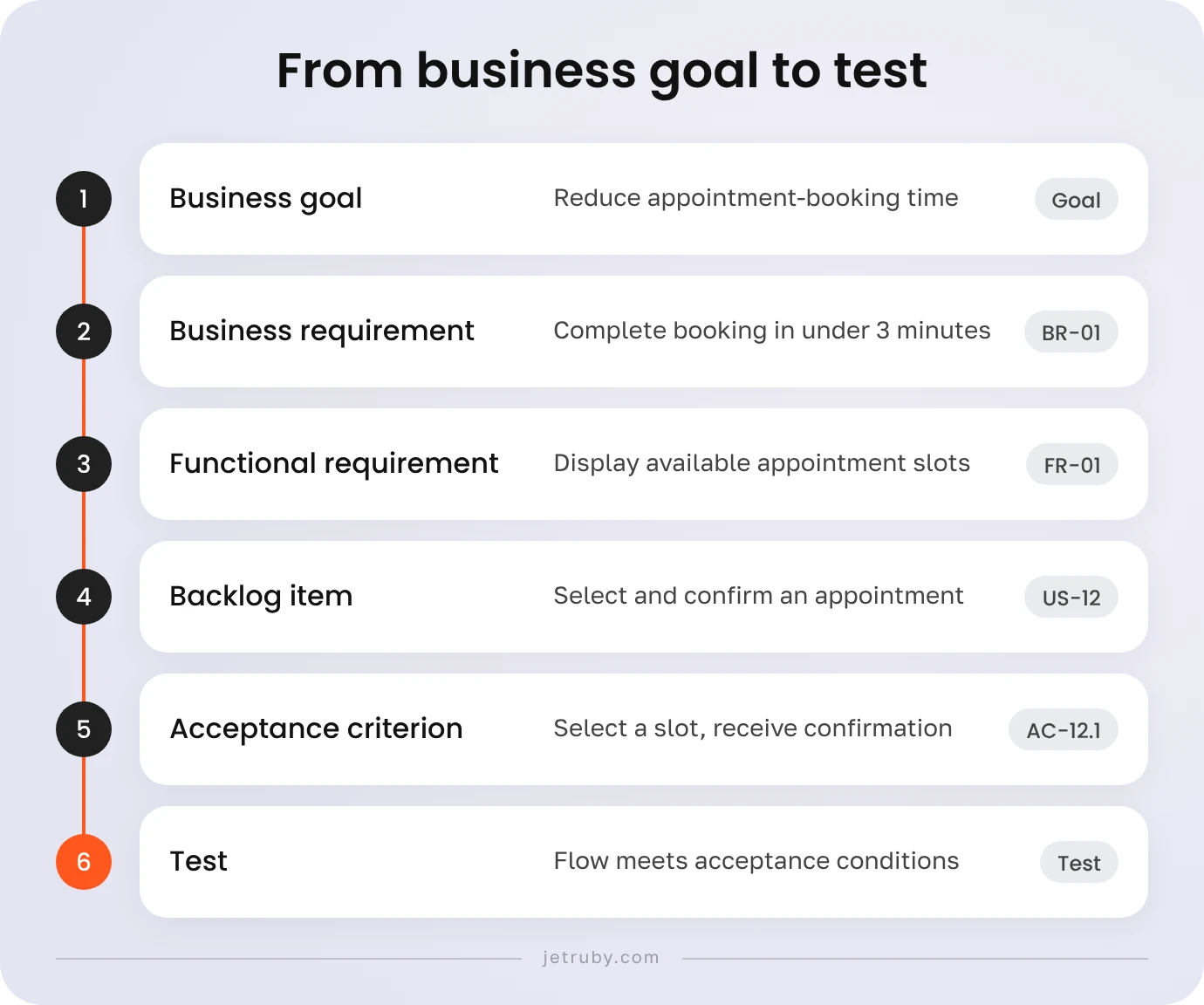
This is where requirements traceability becomes particularly useful. IIBA’s guidance on requirements traceability describes traceability as maintaining relationships between needs, requirements, designs, and the implemented solution.. These relationships help the team understand the consequences of a change and maintain alignment with the original business need.
A simple traceability chain might look like this:
Business Requirements Analysis Example
The following is an illustrative example rather than a real JetRuby client case.
Imagine a healthcare company that wants to introduce digital appointment booking.
The initial business goal is to reduce the average time required to book an appointment from eight minutes to less than three. At the moment, customers have to contact the clinic, wait for staff to check availability, discuss possible times, and then receive confirmation.
The current process therefore looks like:
Customer searches for a doctor → calls the clinic → staff checks availability → staff proposes a slot → customer confirms → staff records the appointment
The proposed future process is:
Customer searches for a doctor → sees available slots → selects a slot → confirms → receives confirmation
At first, the requirements appear straightforward. However, stakeholder discussions reveal a conflict.
The operations manager wants the system to display only appointment slots that have been explicitly approved. This reduces the number of scheduling exceptions staff have to handle.
The marketing manager wants customers to be able to request alternative times when none of the available slots work for them. From the marketing perspective, this could address customers who would otherwise abandon the booking process.
Instead of treating the conflict as a choice between two features, the analysis looks at the underlying needs.
The resulting requirements could be:
BR-01 — Booking speed
The product should reduce the average time required to complete an appointment booking to less than 3 minutes.
BR-02 — Availability
Customers should be able to see currently available appointment slots without requiring staff assistance.
BR-03 — Exception handling
When no suitable slot is available, the product should provide a controlled way to submit an alternative-time request for staff review.
BR-02 can then lead to a functional requirement:
The system must retrieve available appointment slots from the scheduling system and display them to the customer.
The relationship between these statements is important. BR-02 describes the business need, while the functional requirement describes a capability the solution must provide to support it.
An acceptance criterion can make the expected behavior more concrete:
A test user can select an available appointment, confirm the booking, and receive confirmation without staff intervention.
The team can then prioritize the requirements. BR-01 and BR-02 may be treated as Must-have requirements because they directly support the primary booking objective. BR-03 may initially be a Should-have requirement because it addresses an important stakeholder need but is not necessary to demonstrate the core self-service booking flow.
That priority is not permanent. If further research shows that customers frequently abandon the process because they cannot request alternative times, the requirement can be reconsidered.
This is one of the practical benefits of business requirements analysis: it creates a structure for making those decisions instead of turning every stakeholder request into an immediate feature.
Common Mistakes in Business Requirements Analysis
Even a well-defined process can break down if the team confuses business needs with solutions or treats requirements as a static checklist.
One common mistake is starting with features instead of the business problem. “Build a dashboard” may be a useful solution idea, but it does not explain what business outcome the dashboard is expected to support.
Another is treating requirements gathering as analysis. Interviews and workshops provide information, but analysis is what reveals conflicts, dependencies, assumptions, gaps, and priorities.
It is also easy to turn stakeholder preferences into requirements without asking what is behind them. A stakeholder may request a particular feature because it is familiar or because they believe it will solve a problem. Understanding the underlying need keeps the team from committing to a solution before the problem has been properly examined.
Requirements also become difficult to manage when ownership is unclear. If nobody is responsible for making a decision, unresolved questions can remain in the backlog until they become implementation problems.
Finally, vague language such as “fast,” “easy,” “intuitive,” or “user-friendly” can make requirements difficult to verify. Such terms are not necessarily wrong, but they need to be translated into criteria that the relevant stakeholders can evaluate.
A Practical Business Requirements Analysis Checklist
Before moving from analysis into product discovery or development, check whether the following questions have clear answers:
- Is the business problem clearly stated?
- Is there a desired outcome or metric, and is the metric owner identified?
- Have the relevant stakeholders been mapped?
- Have different stakeholder perspectives and potential conflicts been documented?
- Is the current state understood?
- Is the desired future state clear enough to discuss?
- Are scope, constraints, and assumptions documented?
- Does each business requirement connect to a business need or goal?
- Are business, stakeholder, functional, and technical requirements distinguished?
- Have requirements been prioritized using value, risk, urgency, and dependencies?
- Does each important requirement have an owner?
- Are acceptance criteria specific enough to evaluate?
- Have the requirements been verified for clarity and consistency?
- Have they been validated against the business goal?
- Can requirements be traced to backlog items, designs, and tests?
- Is there a clear way to evaluate and document changes?
- Has the resulting scope and context been communicated to the product and development team?
This checklist is a practical recommendation for reviewing the analysis; it is not presented as a proprietary JetRuby process.
From Requirements to Product Discovery
Business requirements analysis answers an important question: what does the business need to achieve, and what requirements follow from that need?
It does not necessarily answer every question about the final product.
Once the problem, stakeholders, desired outcome, constraints, and priorities are clearer, the team can move into product discovery. At this stage, research, prototypes, solution exploration, and technical planning can be used to test assumptions and define a product scope.
The relationship between the stages can therefore be described as:
Business problem → Requirements analysis → Validated requirements → Product discovery → Solution design → Development
The purpose of this sequence is not to create more documentation. It is to reduce uncertainty at the point where decisions are being made.
If the product idea is clear but the requirements are still uncertain, the next step may be to validate the assumptions, clarify the scope, and determine which parts of the solution need further discovery.
Have a product idea but unclear requirements? Turn the goals and assumptions into a testable product scope with JetRuby’s Design and Discovery Phase.
Frequently Asked Questions
When should a team analyze business requirements?
Business requirements analysis is most useful before significant solution or development decisions are made, particularly when the problem, desired outcome, stakeholders, or scope are still unclear. It can also continue later when new information changes the business context or requirements.
Is requirements gathering the same as requirements analysis?
No. Requirements gathering or elicitation is about obtaining information from stakeholders and other relevant sources. Analysis interprets that information, identifies relationships and conflicts, evaluates priorities, clarifies requirements, and connects them to business outcomes.
Who should approve business requirements?
The appropriate decision-maker depends on the organization and initiative. It may be a product owner, business sponsor, process owner, or another person with authority over the relevant business outcome and scope. The important point is that ownership should be explicit.
How do business requirements differ from functional requirements?
Business requirements describe the goals, objectives, or outcomes behind a change. Functional requirements describe what the solution needs to do to support those requirements. IIBA treats functional requirements as part of solution requirements, which are distinct from business and stakeholder requirements.
How can teams resolve conflicting requirements?
Start by identifying the underlying need behind each request rather than comparing the requested features directly. Then consider the business goal, value, risk, urgency, dependencies, and constraints. Workshops, process maps, prototypes, and other concrete artifacts can make the trade-offs easier to discuss.
Is a BRD required for every project?
No. A business requirements document is one possible documentation format. Depending on the project, a team may instead use a product backlog, requirements repository, process models, user stories, acceptance criteria, or several artifacts together.
When should business requirements be revalidated?
Requirements should be revisited when the business goal, assumptions, stakeholders, constraints, or scope change. Validation can also be performed throughout an initiative rather than only once before development.
Ready to validate your requirements? Explore JetRuby’s Design and Discovery Phase.


