The Agentic AI Revolution: How Autonomous AI Assistants Will Transform Software Development in 2026
Discover how Agentic AI — autonomous AI assistants — will transform software development in 2026. Learn about AI-driven coding, testing, and DevOps automation.
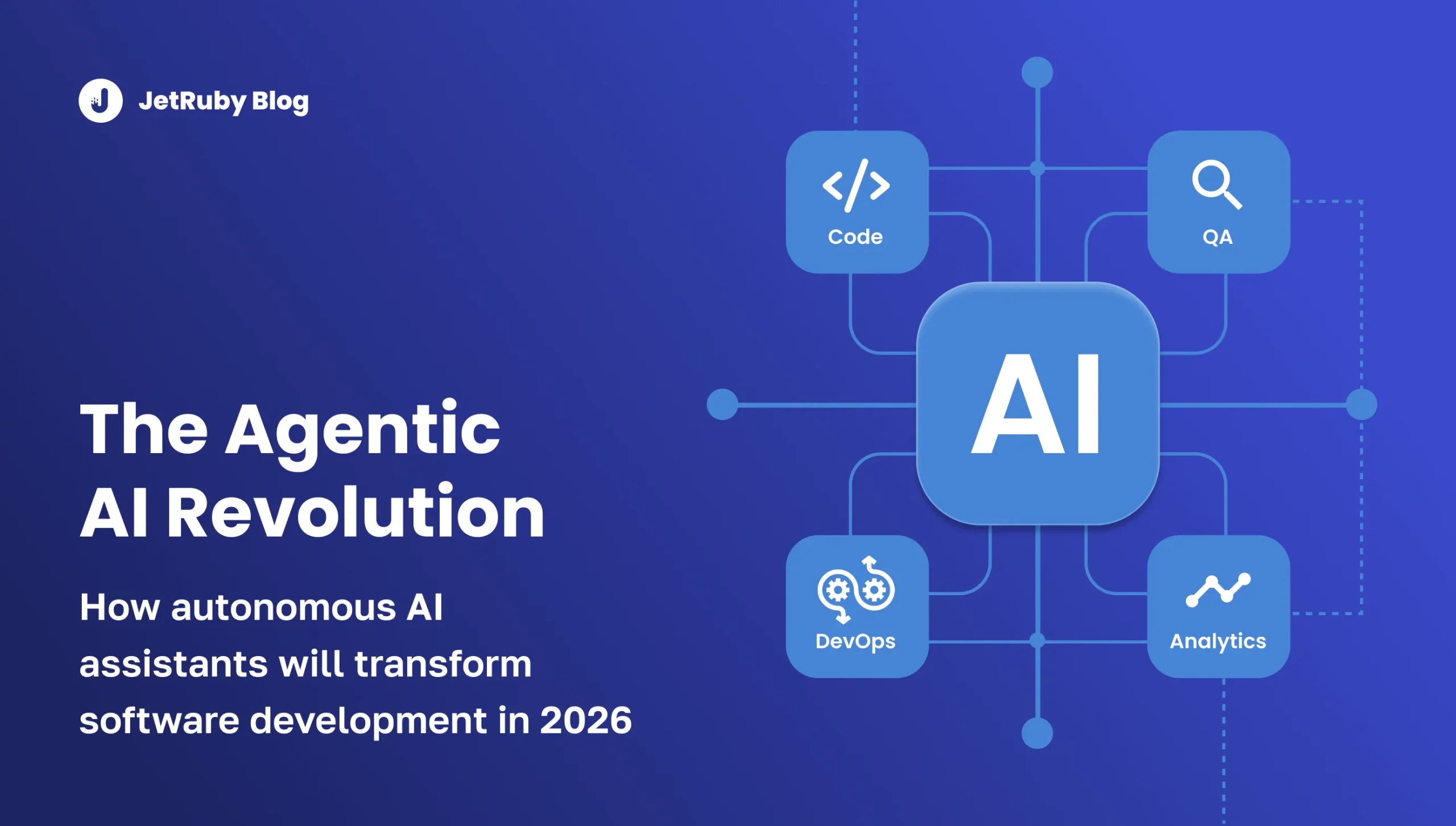

Table of Contents
Today software development is changing faster than ever, and 2026 is shaping up to be a turning point. At the forefront of this evolution is Agentic AI — autonomous AI assistants capable of taking initiative, making decisions, and executing complex tasks with minimal human guidance. For companies building SaaS platforms, enterprise systems, and AI-powered products, these agents are set to redefine how software is developed, tested, and maintained.
From AI Tools to AI Agents
In recent years, AI has primarily served as a tool: helping developers generate code snippets, suggest improvements, or automate repetitive tasks. While these capabilities have significantly boosted productivity, the next stage is far more transformative.
Agentic AI goes beyond assistance — it acts with agency. These AI agents can plan, execute, and iterate on development tasks autonomously. Imagine an AI that can:
- Analyze requirements and draft feature specifications
- Generate and refactor code while following your team’s architecture standards
- Conduct testing, detect bugs, and implement fixes automatically
- Continuously monitor and optimize performance post-deployment
This level of autonomy not only accelerates development cycles but also enables teams to focus on high-value work, such as strategy, design, and innovation.
Why 2026 Will Be the Year of Agentic AI
Several converging trends make 2026 the perfect storm for Agentic AI in software development:
- Maturity of Large Language Models (LLMs)
AI models are now capable of understanding complex instructions, reasoning across multiple tasks, and producing high-quality code in multiple languages. - Integration of AI in CI/CD Pipelines
Continuous integration and deployment workflows are increasingly AI-driven, allowing autonomous agents to deploy, test, and monitor applications in real time. - AI-First Engineering Culture
Forward-thinking companies are adopting “AI-native” development practices — blending human expertise with AI agents to accelerate delivery while maintaining quality and security standards. - Growing Complexity of Software Systems
As software ecosystems become more complex — combining cloud infrastructure, microservices, AI/ML models, and IoT integrations — autonomous agents help manage dependencies and optimize system performance in ways humans alone cannot.
Real-World Applications for Development Teams
The rise of Agentic AI opens up a variety of new possibilities for software teams:
- Autonomous QA: AI agents can generate test cases, run regression tests, and automatically resolve detected issues, reducing release cycles.
- AI-Driven Refactoring: Agents analyze legacy codebases and propose improvements or fully refactor code to improve scalability, security, and maintainability.
- Predictive Performance Optimization: AI continuously monitors system performance and proactively suggests or implements optimizations before bottlenecks occur.
- Smart DevOps Automation: From infrastructure provisioning to automated deployment and rollback, AI agents can manage the full lifecycle of software delivery.
Challenges and Considerations
Despite the excitement, adopting Agentic AI requires careful planning:
- Trust and Verification: Autonomous agents need mechanisms for explainability and oversight to ensure they operate safely.
- Security and Compliance: AI agents must adhere to organizational policies, industry regulations, and data privacy standards.
- Human-AI Collaboration: Teams must strike a balance between agent autonomy and human supervision, fostering a symbiotic development environment.
Why JetRuby Is Ready for the Agentic AI Era
At JetRuby, we’ve been integrating AI into our development workflows for years, from AI-assisted code generation to intelligent QA and automated DevOps. In 2026, we’re taking it further with Agentic AI:
- Combining human expertise with AI autonomy to accelerate project delivery
- Optimizing legacy modernization with AI-driven refactoring
- Building scalable, secure, and AI-optimized systems for international clients
Our approach ensures that technology not only keeps pace with business needs but also opens doors to entirely new ways of creating software.
Looking Ahead
The Agentic AI revolution is no longer a future concept — it is happening now. By 2026, autonomous AI assistants will become indispensable collaborators in software development, helping teams deliver complex, high-quality products faster than ever.
For businesses ready to embrace this change, the opportunity is enormous: faster innovation, lower costs, and software that adapts and improves autonomously. At JetRuby, we’re excited to partner with companies looking to harness the full potential of Agentic AI and shape the next generation of software development.


