Kotlin Multiplatform 2026: AI Apps Without Compromise
KMP or React Native for your AI-powered app? JetRuby compares real-world performance, shared logic, on-device AI support, and team fit. Make the right call.

Table of Contents
AI-powered mobile apps are no longer niche products. In 2026, recommendation engines, personalization, offline inference, AI copilots, and intelligent automation are becoming standard features across consumer and enterprise apps.
At the same time, mobile teams face a difficult technical decision: how do you ship AI-heavy experiences for both iOS and Android without doubling engineering costs or compromising performance?
This is why Kotlin Multiplatform mobile development in 2026 is getting serious attention from CTOs, founders, and product leaders building AI-enabled products.
For years, cross-platform frameworks were mostly evaluated around UI development speed. In 2026, AI workloads are changing the evaluation criteria entirely.
CTOs are now comparing frameworks based on inference latency, offline AI capability, native hardware acceleration access, memory efficiency, and release velocity across platforms.
Today, the conversation has changed. Teams now care about:
- On-device AI inference performance
- Access to native AI and hardware acceleration APIs
- Shared business logic across platforms
- Offline-first AI functionality
- Time-to-market for AI-powered features
- Migration risks from existing React Native or Flutter apps
The good news is that teams today don’t need to choose between native-level performance and cross-platform efficiency.
At JetRuby, we work with both Kotlin Multiplatform and React Native. That matters because the right architecture depends on your product goals, AI requirements, release timelines, and existing team setup — not framework ideology.
If you are exploring Kotlin-based mobile architecture for your next AI-powered app, you can also review our Kotlin development services page.
In this guide, we will compare Kotlin Multiplatform, React Native, and Flutter through the lens of AI-powered mobile products, including on-device inference, shared AI logic, migration strategies, and real-world delivery timelines.
Why Kotlin Multiplatform Is Getting Serious Attention in 2026
A few years ago, Kotlin Multiplatform was often perceived as an experimental technology suited mostly for internal tools or ambitious engineering teams.
That perception has changed significantly. In 2026, KMP is increasingly used for production-grade mobile applications where teams want:
- Shared business logic
- Native UI performance
- Easier platform-specific customization
- Better integration with native SDKs
- Lower duplication across iOS and Android engineering
The biggest shift is happening in AI-heavy applications.
Traditional cross-platform frameworks solved UI reuse first. Kotlin Multiplatform approaches the problem differently. Instead of forcing a fully shared UI layer, KMP focuses on shared logic:
- Networking
- Authentication
- Caching
- State management
- AI pipelines
- Recommendation logic
- Data synchronization
- Offline processing
- Analytics
- Feature orchestration
For AI-powered apps, this distinction is important. Most AI bottlenecks are not related to button rendering or screen layout. They come from:
- Model inference latency
- Memory management
- GPU/NN API access
- Native ML library integration
- Offline processing constraints
- Background execution
- Streaming data pipelines
Kotlin Multiplatform allows teams to centralize AI-related logic while still keeping direct access to platform-native AI frameworks. That combination is one of the main reasons KMP is gaining traction among startups building AI-first mobile products.
Another major reason for KMP adoption is ecosystem maturity. Compared to the early KMP ecosystem, teams in 2026 now benefit from stable tooling, better iOS interoperability, improved Gradle performance, mature libraries like Ktor and SQLDelight, stronger Compose Multiplatform support, and more predictable CI/CD workflows.
For many engineering leaders, this significantly reduces operational risk and makes KMP a realistic long-term option for production mobile applications — especially AI-enabled products that depend on deep platform integrations.
This is particularly relevant for AI-enabled applications where platform-level integrations often matter more than pure UI reuse.
If you are comparing architectures for AI-focused mobile products, our Kotlin Multiplatform vs React Native strategy guide provides additional context.
How Kotlin Multiplatform Works: Shared Logic, Native UI
To understand why KMP is increasingly relevant for AI-powered apps, it helps to look at its architecture.
The core idea behind Kotlin Multiplatform architecture is simple:
- Share business logic across platforms
- Keep native UI layers for iOS and Android
In practice, teams typically share:
- API clients
- Repository layers
- Authentication flows
- Data models
- AI orchestration logic
- Offline synchronization
- Recommendation engines
- Analytics
- Feature flags
- Business rules
Meanwhile, UI remains platform-specific:
- SwiftUI or UIKit on iOS
- Jetpack Compose or Android Views on Android
This creates a hybrid structure where the app feels fully native on both platforms while still reducing duplicated engineering effort.
For AI-powered products, this model has major advantages. For example, an AI recommendation system may include shared ranking logic, inference orchestration, caching strategies, prompt-processing pipelines, and personalization logic inside a common KMP module.
But platform-specific layers may still handle:
- Core ML acceleration on iOS
- Android NN API integration
- Camera APIs
- Background execution
- Native GPU access
- Platform-specific optimization
KMP gives teams flexibility where they actually need it.
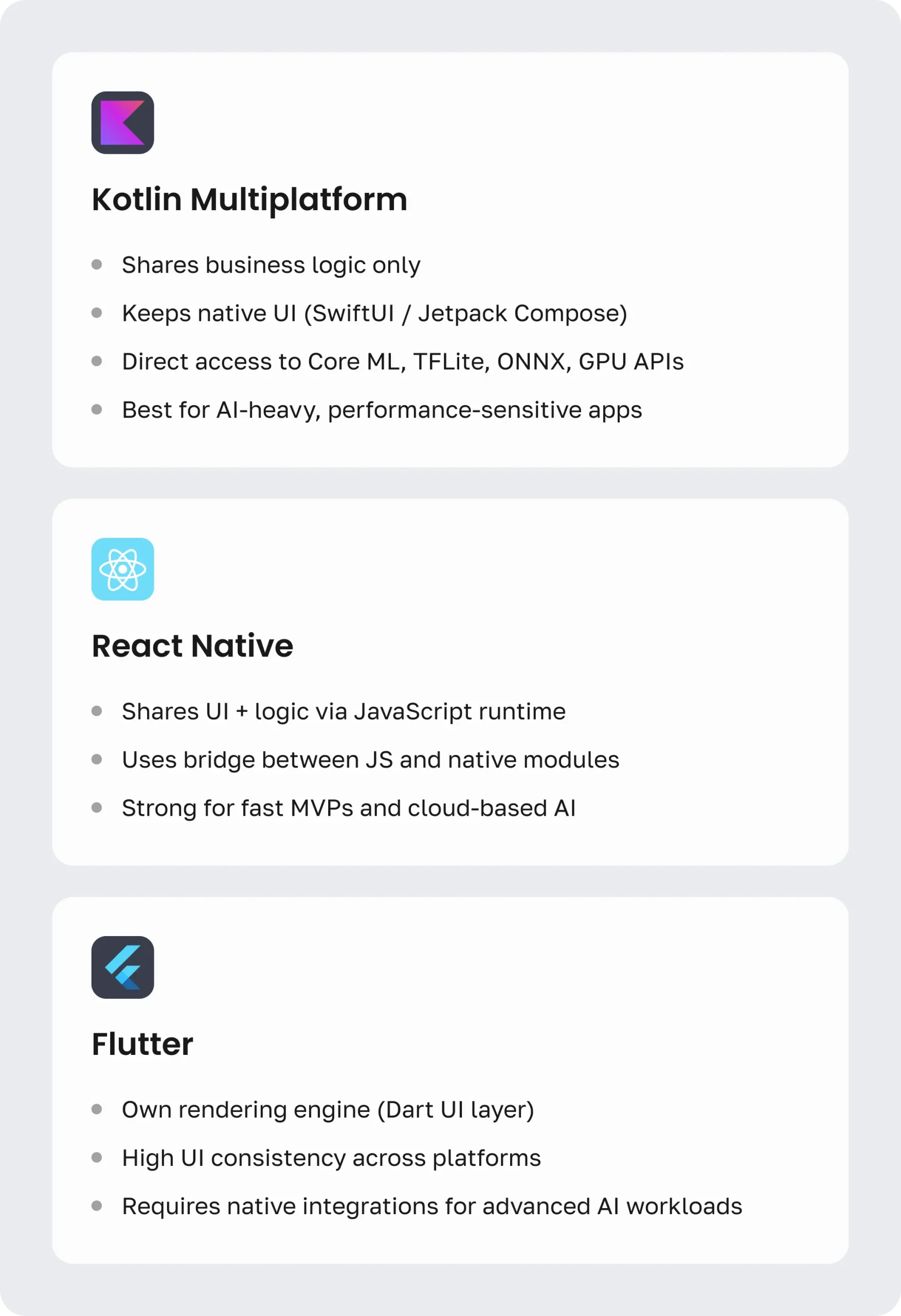
How This Differs from React Native
React Native approaches cross-platform development differently. Instead of sharing only business logic, teams typically share large parts of the application stack, including UI components, navigation, state management, and core application logic across both iOS and Android.
The framework relies on a JavaScript runtime and communication bridges between JavaScript and native modules. For standard business applications, this can work extremely well.
But AI-heavy apps often require efficient handling of large model binaries, real-time inference, native threading optimization, GPU acceleration, intensive background processing, and low-latency camera pipelines — all areas where deep native integration becomes increasingly important.
In these cases, heavy native integrations may introduce architectural complexity.
React Native can absolutely support AI features. Many successful products use this approach. However, as AI workloads become more performance-sensitive, teams often end up writing more native modules anyway.
That reduces some of the original simplicity advantages of React Native.
How This Differs from Flutter
Flutter takes another path. Instead of using native UI components, Flutter renders its own UI engine using Dart.
Its main advantages include consistent UI across platforms, strong animation capabilities, and fast iteration for design-heavy products.
However, AI-intensive applications may still require platform-specific native integrations such as TensorFlow Lite, Core ML, ONNX Runtime, camera pipelines, and hardware acceleration.
This means Flutter teams may still encounter native integration complexity when advanced AI functionality becomes central to the product.
In AI contexts, Kotlin Multiplatform often stands out because it allows shared AI and business logic while preserving native performance access, native UI fidelity, and easier integration with platform ML frameworks.
That does not make KMP universally better, but for certain categories of AI-powered mobile apps it creates a very practical middle ground.
Kotlin Multiplatform vs React Native vs Flutter for AI-Powered Apps
The best framework depends heavily on your product requirements. If your application mainly needs:
- CRUD workflows
- Standard dashboards
- Marketplace flows
- Social features
- Rapid MVP delivery
React Native or Flutter may still be the fastest route.
But if your roadmap includes:
- Real-time AI inference
- On-device ML
- Personalized recommendations
- Offline AI functionality
- Native camera processing
- Low-latency experiences
then architecture choices become more important.
Below is a practical comparison from the perspective of AI-powered mobile products.
| Dimension | Kotlin Multiplatform | React Native | Flutter |
| UI Approach | Native UI | Shared JS UI | Shared Dart-rendered UI |
| Shared Code | Business logic | UI + logic | UI + logic |
| Native API Access | Excellent | Good with bridges | Good with platform channels |
| On-device AI Integration | Strong | Moderate to strong | Moderate to strong |
| Core ML / TFLite / ONNX Access | Direct native integration | Often requires custom modules | Often requires plugins or native layers |
| AI Inference Performance | Near-native | Depends on bridge overhead | Good, but native integration still needed |
| Offline AI Capability | Strong | Possible but more complex | Strong with native integrations |
| UI Consistency Across Platforms | Platform-native | Shared UI | Highly consistent |
| Time-to-Market for MVPs | Moderate-fast | Very fast | Fast |
| Long-Term Scalability | Strong for complex apps | Strong with careful architecture | Strong |
| Hiring Availability | Smaller talent pool | Large talent pool | Medium-sized talent pool |
| Migration Flexibility | Excellent for gradual adoption | Strong ecosystem | Strong ecosystem |
| Best Fit | AI-heavy products with native requirements | Fast-moving startups and standard apps | Design-heavy apps |
The key AI-related distinction is where inference and ML orchestration happen.
In many React Native projects, AI-critical components gradually move into native code over time. This is especially common when teams encounter inference latency spikes, camera-processing bottlenecks, memory pressure during local inference, or offline synchronization complexity.
In practice, many AI-focused mobile teams end up with hybrid architectures regardless of their original framework choice.
With KMP, shared logic can remain centralized while still accessing native AI frameworks directly.
That often results in:
- Cleaner architecture
- Lower latency
- Easier debugging
- Better offline support
- Improved memory management
- More predictable performance
However, React Native still remains an excellent option for many startups. If your AI functionality primarily depends on cloud inference APIs rather than heavy on-device processing, React Native may provide faster early-stage delivery.
This is why stack selection should always follow product strategy.
For a deeper comparison, see our detailed KMP vs React Native strategy guide.
On-Device AI with Kotlin Multiplatform
One of the most important shifts in mobile AI is the move toward on-device inference. Teams increasingly want AI features that work:
- Offline
- With lower latency
- With stronger privacy guarantees
- Without constant API costs
- With better personalization
Modern mobile AI stacks often combine:
- TensorFlow Lite
- ONNX Runtime
- Core ML
- GPU acceleration
- Android NN API
- Apple Neural Engine optimization
Kotlin Multiplatform works particularly well in these scenarios because it separates shared orchestration logic from platform-specific inference execution.
Typical KMP AI Architecture
A typical Kotlin Multiplatform AI architecture usually separates shared logic from platform-specific UI.
In this setup, a shared Kotlin Multiplatform module is used across both iOS and Android to implement the core application intelligence. This includes AI-related business logic, feature orchestration, recommendation pipelines, user personalization, data preprocessing, prompt formatting, caching mechanisms, networking, analytics tracking, and offline synchronization.
By keeping these components in a shared layer, teams reduce duplication and ensure consistent AI behavior across platforms, while still allowing each platform to handle its own native UI and device-specific optimizations.
Native Platform Layers
Platform-specific:
iOS
- Core ML integration
- Apple Neural Engine optimization
- SwiftUI UI layer
- Native memory optimization
Android
- TensorFlow Lite or ONNX Runtime
- Android NN API
- Jetpack Compose UI
- GPU acceleration
This architecture provides two major benefits:
- Shared AI product logic across platforms
- Native-level performance where it matters most
That is a powerful combination for AI-powered apps.
Scenario A: AI Recommendation Startup
Imagine a Seed-stage startup building a personalized recommendation platform for both iOS and Android.
Requirements include:
- Real-time recommendations
- Offline personalization
- On-device ranking
- Native camera integration
- Low-latency UX
- Simultaneous release on both platforms
A fully separate native implementation would require:
- Two AI orchestration pipelines
- Duplicated business logic
- Separate caching systems
- Independent recommendation logic
- Higher QA complexity
With Kotlin Multiplatform, the team can share:
- Recommendation engine logic
- User profiling rules
- Ranking algorithms
- Data synchronization
- Feature orchestration
Meanwhile, native layers still handle platform-specific inference optimization.
In practical terms, teams often report roughly 25–35% savings in total mobile engineering effort compared to fully separate native implementations.
The largest gains usually come from shared recommendation pipelines, ranking logic, caching layers, networking infrastructure, and personalization systems. In many projects, duplicated business-logic code can be reduced by 40–60% while still preserving native UX quality.
The exact number depends on AI complexity, existing infrastructure, product scope, and the level of platform-specific UI customization required.
But for many startups, that reduction is substantial enough to accelerate launch timelines without sacrificing performance. This is one of the strongest arguments for KMP for production apps in AI-heavy environments.
Kotlin Multiplatform Limitations Developers Should Know
Kotlin Multiplatform is powerful, but it is not a silver bullet. Teams evaluating KMP should understand its tradeoffs clearly.
UI Is Still Platform-Specific
Unlike React Native or Flutter, KMP doesn’t magically eliminate platform-specific UI development. Teams still need:
- iOS UI expertise
- Android UI expertise
- Native design implementation
- Platform testing
This can actually be an advantage for products that require premium UX quality. But teams expecting a fully shared UI stack may be surprised.
Smaller Ecosystem Compared to React Native
React Native has:
- A larger community
- More plugins
- More prebuilt integrations
- Larger hiring pools
- Faster onboarding for some teams
KMP’s ecosystem is growing, but it is still smaller than more established cross-platform frameworks, which means some integrations may require more custom development, additional architectural planning, and stronger native engineering expertise.
Tooling Complexity
Kotlin Multiplatform development often involves:
- Gradle configuration
- Dependency management complexity
- Native interoperability setup
- Build optimization
- Xcode and Android Studio coordination
Teams unfamiliar with Kotlin ecosystems may face an initial learning curve.
Hiring Can Be Harder
Experienced KMP engineers are still less common than React Native or Flutter developers.
This matters for:
- Scaling internal teams
- Long-term hiring
- Maintenance planning
- Migration projects
For critical AI products, many companies choose to work with teams that already have practical KMP experience rather than building internal expertise from scratch. That approach can significantly reduce delivery risk.
KMP Is Not Always the Best Choice
There are many cases where React Native or Flutter remain excellent solutions. For example:
React Native Is Often Better When:
- You need an MVP extremely fast
- Most AI inference happens in the cloud
- Your existing team already knows RN
- UI sharing is the top priority
- Product complexity is still evolving
Flutter Is Often Better When:
- You need highly custom UI
- Visual consistency is critical
- Animation-heavy UX is central
- Design systems are complex
KMP Is Often Better When:
- Native performance matters
- AI inference is performance-sensitive
- Offline AI is important
- Native integrations are extensive
- Long-term maintainability matters
- Teams want gradual migration flexibility
Understanding these tradeoffs is more valuable than blindly following trends.
How Long Does It Take to Build a Kotlin Multiplatform App
One of the biggest questions founders ask is simple: “How long will this actually take?”
The answer depends heavily on product scope, AI complexity, existing infrastructure, team composition, native integration requirements, design readiness, external API dependencies, and migration constraints, although realistic benchmarks can still provide useful guidance.
Case: Moments NFC
One example is Moments NFC — an Android Kotlin application developed for pubs in the United States.
The project involved:
- Kotlin Android development
- NFC payment functionality
- Adapting an existing iOS design
- Rapid delivery requirements
The application was completed in just 12 days. This project demonstrates an important point: Kotlin teams can move extremely fast when architecture and scope are aligned properly. Fast delivery is not exclusive to React Native.
Case: Build a Kotlin App in 2 Weeks
Another JetRuby benchmark comes from our “Build a Kotlin app in 2 weeks” project.
The case highlights how structured Kotlin development workflows can significantly accelerate delivery timelines while maintaining production quality.
You can read the full story here: our “Build a Kotlin app in 2 weeks” case study
Typical AI App Timelines
Timelines for AI-powered products vary significantly because the complexity of AI integration differs from one application to another.
Greenfield KMP AI App
For a new Kotlin Multiplatform AI application, a typical MVP usually takes around 8–16 weeks to deliver.
This estimate depends on several key factors, including the number of AI features, the complexity of on-device inference, the maturity of the backend infrastructure, overall product scope, design complexity, authentication flows, and offline support requirements.
Existing React Native App with AI Expansion
Typical hybrid migration timeline:
- 4–10 weeks for first AI-critical module
This is where hybrid architectures become extremely valuable.
Scenario B: React Native + KMP Hybrid Architecture
One of the biggest misconceptions around Kotlin Multiplatform is that migration requires a full rewrite. In reality, most successful migrations happen incrementally.
A practical migration path often looks like this:
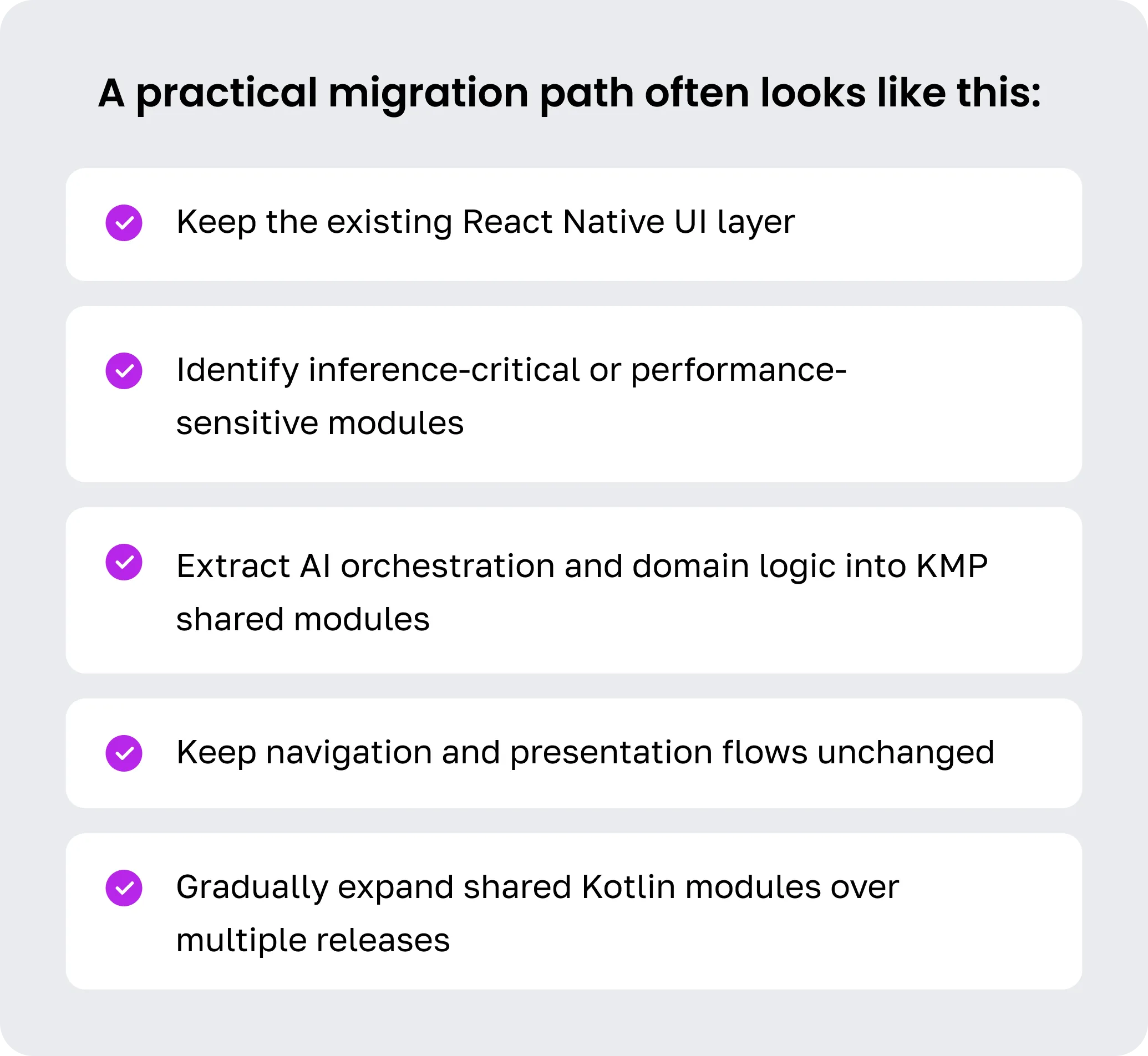
- Keep the existing React Native UI layer
- Identify inference-critical or performance-sensitive modules
- Extract AI orchestration and domain logic into KMP shared modules
- Keep navigation and presentation flows unchanged
- Gradually expand shared Kotlin modules over multiple releases
This approach minimizes release disruption, QA complexity, team retraining pressure, product delivery delays, and migration risk. It also allows teams to validate performance improvements before committing to larger architectural changes.
Scenario B: React Native + KMP Hybrid Architecture
Imagine a company already has:
- A mature React Native app
- Shared JS UI
- Existing release pipeline
- Product-market fit
But new AI features create problems:
- Slow inference
- Memory issues
- Native integration complexity
- Camera processing bottlenecks
- Offline performance limitations
Instead of rebuilding the entire app, JetRuby may recommend:
- Keeping React Native for UI
- Introducing Kotlin Multiplatform for AI modules
- Gradually migrating performance-critical logic
This approach significantly reduces risk while enabling more flexible evolution of the product.
The benefits typically include faster migration, lower rewrite costs, improved inference performance in critical flows, incremental adoption of new architecture components, and continued feature delivery during transition.
In practice, this hybrid approach is increasingly common in AI-focused mobile products. In real-world client engagements, companies rarely adopt KMP as a full replacement for their existing stack. Instead, it is used as a targeted optimization layer for performance-critical and architecture-sensitive parts of the system.
This distinction is important because the goal is rarely to rewrite everything from scratch. In most cases, teams aim to improve inference-heavy performance, reduce duplicated mobile logic, maintain high release velocity, extend the lifespan of existing React Native investments, and gradually enable more advanced AI capabilities.
This reflects a broader engineering reality: architecture decisions should optimize business outcomes rather than framework ideology.
If React Native remains the best strategic choice, we recommend keeping it. If Kotlin Multiplatform provides measurable long-term performance or architectural advantages, we clearly identify where it adds value and why.
This pragmatic approach is often what matters most for founders and CTOs. The best architecture is typically the one that ships reliably, supports future AI growth, minimizes migration risk, and keeps mobile teams productive over time.
You can also explore our broader perspective on AI-powered mobile products in our analysis of AI-powered mobile development trends.
Conclusion and Next Steps
Kotlin Multiplatform has matured significantly by 2026. For AI-powered mobile applications, it offers a compelling combination of:
- Shared business logic
- Native performance
- Direct access to AI frameworks
- Flexible architecture
- Strong long-term scalability
- Better support for on-device AI
At the same time, React Native and Flutter remain excellent choices for many products.
The right decision depends on:
- Your AI requirements
- Existing codebase
- Product roadmap
- Team expertise
- Time-to-market priorities
- Offline functionality needs
- Native integration complexity
For some startups, React Native will still provide the fastest path to launch. For others, especially products with performance-sensitive AI features, Kotlin Multiplatform can become a major competitive advantage. And in many real-world cases, a hybrid architecture delivers the best balance.
At JetRuby, we work with startups and product teams building AI-enabled mobile applications across Kotlin Multiplatform, React Native, native iOS/Android, and hybrid architectures.
That experience allows us to recommend architecture based on product goals, AI requirements, and time-to-market constraints — not framework ideology.
If you are planning an AI-powered mobile product, migrating from React Native, or evaluating Kotlin Multiplatform for production, we can help define the right architecture strategy.
👉 Planning an AI-Powered Mobile App or React Native Migration? Discuss your Kotlin Multiplatform or React Native AI project with JetRuby.
FAQ
Is Kotlin Multiplatform ready for production in 2026?
Yes. Kotlin Multiplatform is increasingly used for production-grade mobile applications, especially where teams need shared business logic combined with native platform performance. While the ecosystem is still smaller than React Native, KMP has matured significantly in tooling, interoperability, and production stability.
How does Kotlin Multiplatform compare to React Native for AI apps?
Kotlin Multiplatform is often stronger for AI-heavy mobile applications that require native performance, on-device inference, GPU acceleration, or deep platform integrations. React Native remains an excellent option for rapid MVP development and apps where AI functionality mainly relies on cloud APIs.
Can you run on-device AI models with Kotlin Multiplatform?
Yes. Teams commonly integrate TensorFlow Lite, ONNX Runtime, and Core ML with Kotlin Multiplatform architectures. Shared KMP modules can orchestrate AI pipelines and business logic, while native layers handle platform-specific inference optimization.
What are the limitations of Kotlin Multiplatform?
The biggest limitations include:
- Platform-specific UI development
- Smaller ecosystem compared to React Native
- More complex tooling setup
- Smaller hiring pool for experienced KMP engineers
However, these tradeoffs are often acceptable for products that prioritize native performance and AI-intensive functionality.
How long does it take to build a KMP app?
Timelines depend on scope and AI complexity. A simple Kotlin application can sometimes be delivered within 2–4 weeks, while AI-powered production apps typically require 8–16 weeks for an MVP. Hybrid migration strategies from React Native to KMP can reduce delivery risk and shorten transition timelines.


